


Air Pollution Control Systems Market Analysis: Key Growth Drivers and Future Prospects Through 2034
air pollution control systems are expected to remain important for industrial environmental management. Advancements in filtration, gas treatment, and smart monitoring will improve system performance. Growing industrialization and sustainability initiatives will create new opportunities. Continuous technological development will support long-term industry expansion.
Air Pollution Control Systems Market Overview
The Global Air Pollution Control Systems Market is experiencing significant growth due to increasing environmental concerns, stricter government regulations, rising industrial emissions, and growing awareness of air quality management. Air pollution control systems are designed to remove harmful pollutants, particulate matter, and toxic gases from industrial exhaust streams and other emission sources. These systems play an important role in reducing environmental pollution and protecting public health.
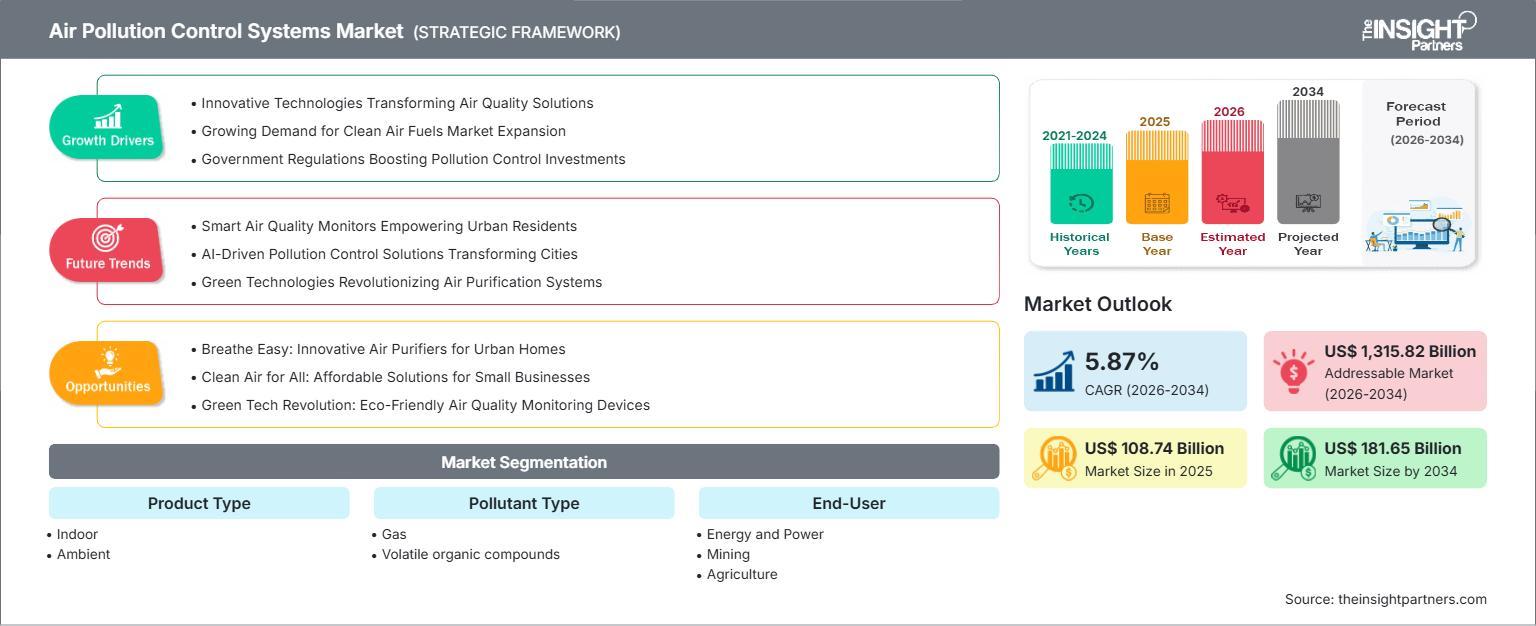
The air pollution control systems market is projected to grow from US$ 108.74 Billion in 2025 to US$ 181.65 Billion by 2034, registering a CAGR of 5.87% during 2026–2034. Increasing industrialization, urban development, and the implementation of stringent emission standards are among the major factors supporting market expansion.
Get a PDF Sample: https://www.theinsightpartners.com/sample/TIPRE00007292
Industries such as power generation, chemicals, cement, pharmaceuticals, oil and gas, and manufacturing are increasingly adopting advanced pollution control technologies to comply with environmental regulations. Technologies such as electrostatic precipitators, scrubbers, fabric filters, catalytic converters, and thermal oxidizers are widely used to control industrial air emissions.
Furthermore, growing investments in sustainable industrial operations and clean technologies are encouraging businesses to implement efficient air pollution control solutions.
Key Market Drivers and Emerging Trends
One of the major drivers of the Air Pollution Control Systems Market is the increasing implementation of environmental regulations across developed and developing economies. Governments and environmental agencies are introducing stricter emission limits to reduce harmful pollutants, including sulfur dioxide (SO2), nitrogen oxides (NOx), volatile organic compounds (VOCs), and particulate matter.
The rapid expansion of industrial activities is another important growth factor. Manufacturing plants, power stations, refineries, and chemical processing facilities generate significant air emissions, increasing the demand for effective pollution control equipment.
Technological advancements are also transforming the industry. Manufacturers are developing advanced filtration systems, high-efficiency scrubbers, and automated emission monitoring solutions to improve pollutant removal performance and reduce operational costs. The integration of artificial intelligence, sensors, and digital monitoring technologies is helping industries monitor emissions more accurately and optimize equipment performance.
Additionally, increasing awareness of respiratory health risks and environmental sustainability is encouraging investments in advanced air quality management systems.
Air Pollution Control Systems Market Segmentation
The Air Pollution Control Systems Market is segmented based on product type, pollutant type, and end-user.
By Product Type
-
Scrubbers
-
Electrostatic Precipitators
-
Fabric Filters and Baghouse Filters
-
Catalytic Converters
-
Thermal Oxidizers
-
Other Air Pollution Control Equipment
By Pollutant Type
-
Gaseous Pollutants
-
Particulate Matter
-
Volatile Organic Compounds (VOCs)
-
Sulfur Oxides (SOx)
-
Nitrogen Oxides (NOx)
-
Other Pollutants
By End-User
-
Power Generation
-
Chemical and Petrochemical
-
Cement and Manufacturing
-
Oil and Gas
-
Pharmaceuticals
-
Food and Beverage
-
Automotive
-
Other Industries
Among these segments, scrubbers, electrostatic precipitators, and filtration systems are important product categories because of their widespread use in industrial emission management. Demand for gaseous pollutant treatment and particulate matter removal is also increasing as industries focus on meeting environmental compliance requirements.
The power generation, chemical, cement, and manufacturing industries represent important end-user segments due to their significant emission levels and increasing investments in pollution control infrastructure.
Leading Companies in the Air Pollution Control Systems Market
The global Air Pollution Control Systems Market includes several established companies that focus on technological innovation, product development, strategic partnerships, and expansion of industrial pollution management solutions.
Key players operating in the market include:
-
Babcock & Wilcox Enterprises, Inc.
-
Daikin Industries, Ltd.
-
Donaldson Company, Inc.
-
ELEX AG
-
GEA Group Aktiengesellschaft
-
General Electric Company
-
Hamon Group
-
MANN+HUMMEL International GmbH & Co. KG
-
Mitsubishi Heavy Industries, Ltd.
-
Thermax Limited
These companies are investing in advanced filtration technologies, emission reduction equipment, and energy-efficient pollution control solutions. Their focus on improving equipment performance and developing environmentally sustainable technologies is strengthening competition in the global market.
Future Outlook of the Air Pollution Control Systems Market
The future of the Air Pollution Control Systems Market looks promising, supported by increasing environmental regulations, industrial expansion, and growing investments in clean air technologies. Governments worldwide are expected to continue implementing stricter emission standards, encouraging industries to upgrade existing pollution control equipment and adopt advanced emission treatment systems.
The increasing adoption of smart monitoring technologies, automated filtration systems, and energy-efficient pollution control equipment is expected to create new growth opportunities. Furthermore, developing economies are likely to witness rising demand as industrialization and urbanization increase the need for effective air quality management.
The transition toward sustainable manufacturing and cleaner industrial processes will also encourage companies to invest in innovative pollution control technologies.
Overall, rising environmental awareness, stricter emission regulations, industrial development, and technological advancements are expected to remain the major factors driving the global Air Pollution Control Systems Market through 2034.
Related Reports:
Sand Control Systems Market Growth, Trends & Forecast by 2034
Industrial Emission Control Systems Market Trends, Share & Demand by 2034
About Us
The Insight Partners is a leading market research and consulting firm delivering actionable insights through in-depth industry analysis and strategic intelligence. The firm supports clients across various industries in making informed decisions by providing comprehensive market forecasts, competitive assessments, and growth opportunities.
Contact Us:
If you have any queries about this report or if you would like further information, please contact us:
Contact Person: Ankit Mathur
E-mail: sales@theinsightpartners.com
Also Available in : Korean | German | Japanese | French | Chinese | Italian | Spanish

 English
 Arabic
 French
 Spanish
 Portuguese
 Deutsch
 Turkish
 Dutch
 Italiano
 Russian
 Portuguese (Brazil)
 Greek