


PPE Glove Market Forecast 2025–2035: Industry Developments and Regional Insights
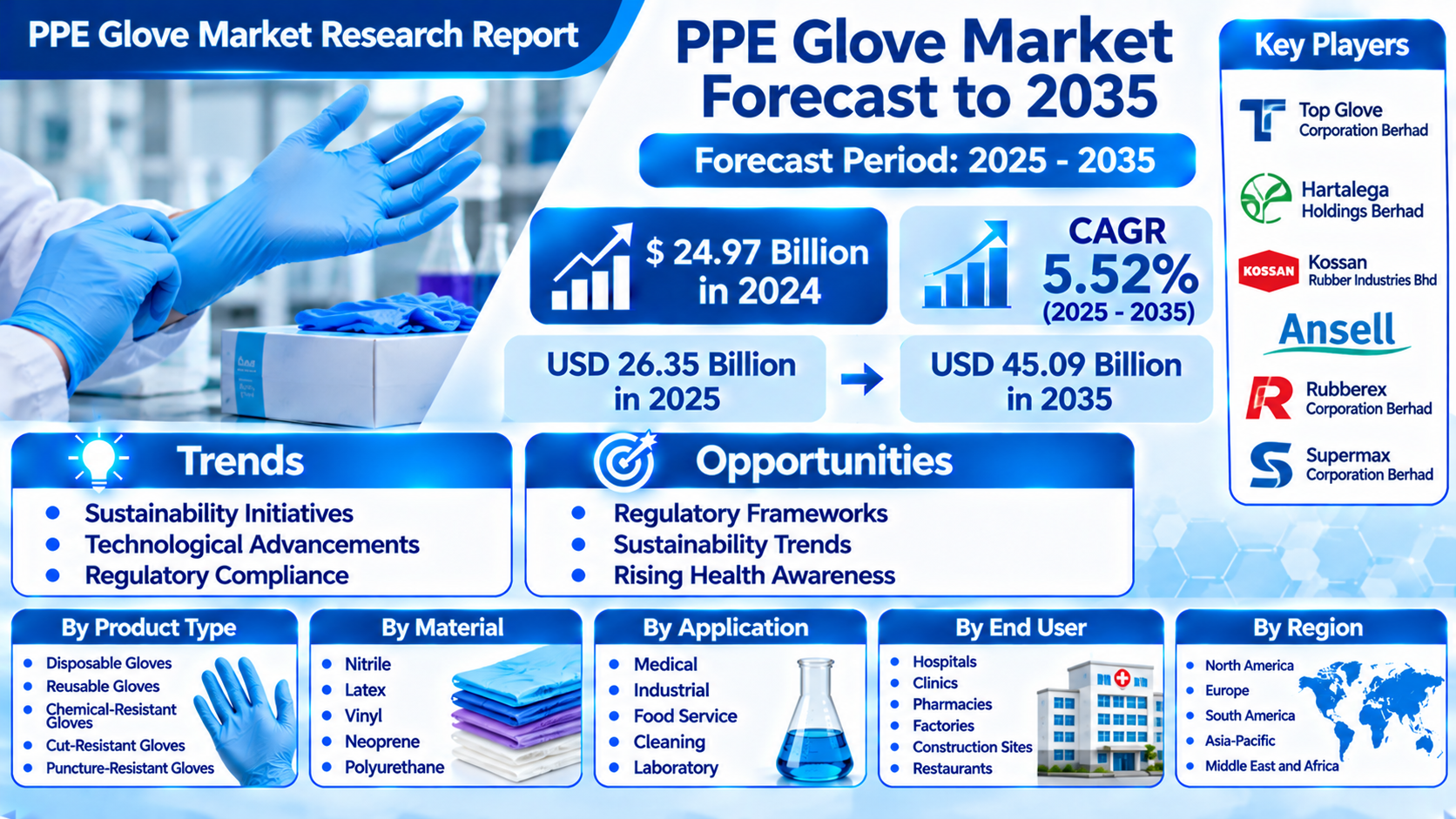
According to Market Research Future® (MRFR), the PPE Glove Market is expected to reach USD 45.09 Billion by 2035, increasing from USD 26.35 Billion in 2025 at a CAGR of 5.52% over the 2025–2035 forecast period. The market recorded a valuation of USD 24.97 Billion in 2024. Its growth reflects the broad use of personal protective gloves in healthcare, industrial operations, food service, cleaning and laboratory work, alongside ongoing attention to workplace safety, regulatory requirements and health awareness.
Market Development and Demand Landscape
Protective gloves are an essential category of personal protective equipment for organizations and individuals working in environments where hand protection is required. The PPE glove market serves a broad range of activities, from medical and laboratory work to manufacturing, construction, restaurant operations and cleaning. This variety of applications creates demand for products with different designs, materials and protective characteristics.
The market's projected rise to USD 45.09 Billion by 2035 highlights the importance of protective gloves across multiple end-user industries. The increase from USD 26.35 Billion in 2025 corresponds to a forecast CAGR of 5.52%. Rather than depending on one application alone, the market is supported by demand from several sectors with distinct requirements for protective equipment.
Healthcare facilities represent an important user group, including hospitals, clinics and pharmacies. Industrial users such as factories and construction sites also contribute to demand, while restaurants and other food service operations require gloves suited to their activities. These varied purchasing environments help sustain a broad market for disposable, reusable and specialized products.
Factors Supporting Market Growth
Workplace safety and regulatory compliance are central considerations in the PPE glove industry. Employers and organizations must account for the protective equipment needed in their operating environments, and regulatory frameworks can influence product selection. This creates an ongoing role for gloves in procurement decisions across healthcare, industrial and service-based workplaces.
Rising health awareness is another opportunity for the market. Greater attention to hygiene and personal protection supports the relevance of gloves in medical, cleaning and food service applications. Demand also extends to laboratories and industrial settings, where protective equipment is part of broader workplace practices.
The industry is experiencing several trends that influence its development. Sustainability initiatives are encouraging attention to environmental considerations in the production and selection of protective gloves. Technological advancements represent another important trend, supporting continued interest in product and material development. Regulatory compliance remains a significant consideration for manufacturers and buyers as they respond to requirements associated with different applications and end users.
Product and Material Categories
Product type is a major basis for market segmentation. The industry includes disposable gloves and reusable gloves, alongside chemical-resistant, cut-resistant and puncture-resistant gloves. These categories address different usage conditions and protective requirements. Disposable products serve applications involving single-use requirements, while reusable options are intended for settings where repeated use is appropriate. Specialized categories provide choices for users seeking particular forms of protection.
The material landscape includes nitrile, latex, vinyl, neoprene and polyurethane. The presence of multiple materials reflects the need to serve varied applications and purchasing specifications. Buyers may consider the intended task, workplace requirements and product characteristics when selecting an appropriate glove category.
Material and product-type choices are relevant across the market's application segments. Medical users, industrial facilities, food service operators, cleaning services and laboratories do not necessarily have identical requirements. Consequently, manufacturers participate in a market where product range and application suitability are important considerations.
Application and End-User Structure
The application segmentation covers medical, industrial, food service, cleaning and laboratory uses. Medical applications are associated with healthcare environments, while industrial demand comes from workplaces that incorporate protective equipment into their operating practices. Food service and cleaning applications broaden the market beyond healthcare and manufacturing. Laboratory use represents another distinct category in which gloves form part of the protective equipment requirements.
The market's end-user segmentation includes hospitals, clinics, pharmacies, factories, construction sites and restaurants. Hospitals and clinics are important healthcare purchasing environments, while pharmacies are also included among the identified end users. Factories and construction sites represent industrial and worksite demand. Restaurants contribute to the food service segment, reflecting the role of gloves in commercial food-related operations.
This distribution across applications and end users gives the industry a diversified demand base. Purchasing requirements can differ according to the work being performed, the materials handled and the relevant safety expectations. As a result, the market encompasses both general-purpose glove categories and products designed for more specific protective needs.
Regional Coverage and Competitive Environment
The PPE glove market is assessed across North America, Europe, South America, Asia-Pacific, and the Middle East and Africa. These regions encompass different industrial structures, healthcare environments and regulatory conditions. Their respective market conditions are influenced by local demand from medical facilities, manufacturing operations, construction activities, food service businesses and cleaning applications.
The competitive landscape includes Top Glove Corporation Berhad, Hartalega Holdings Berhad, Kossan Rubber Industries Bhd, Ansell Limited, Rubberex Corporation Berhad and Supermax Corporation Berhad. These companies are identified as key players in the market. Competition is shaped by the range of glove products and materials offered, as well as the ability to serve different application and end-user requirements.
Sustainability initiatives, technological advancements and regulatory compliance remain relevant themes for companies operating in this sector. Manufacturers must consider the different requirements of customers across healthcare, industrial and service environments while responding to broader changes in purchasing expectations.
Opportunities and Industry Outlook
Regulatory frameworks, sustainability trends and rising health awareness are the key opportunities identified for the PPE glove market. Regulatory considerations can influence the adoption and procurement of protective gloves across a range of workplaces. Growing attention to health and hygiene also supports demand in medical, cleaning and food service settings, while industrial users maintain requirements linked to workplace protection.
Sustainability trends offer scope for manufacturers to address environmental considerations in product development and production. Technological advancements may further influence product offerings and material options as the industry responds to changing application needs. These opportunities are relevant across the market's diverse customer base rather than being limited to a single end-use sector.
With a projected CAGR of 5.52% between 2025 and 2035, the PPE glove market is positioned for continued expansion. Its forecast valuation of USD 45.09 Billion by 2035 reflects the combined relevance of healthcare, industrial and service-sector demand. The industry's future development will continue to be influenced by regulatory compliance, sustainability priorities, technological progress and awareness of workplace protection.

 English
 Arabic
 French
 Spanish
 Portuguese
 Deutsch
 Turkish
 Dutch
 Russian
 Romaian
 Portuguese (Brazil)
 Greek