


Sludge Dewatering Equipment Market Growth, Key Players, SWOT, Revenue Analysis Analysis By Fact.MR
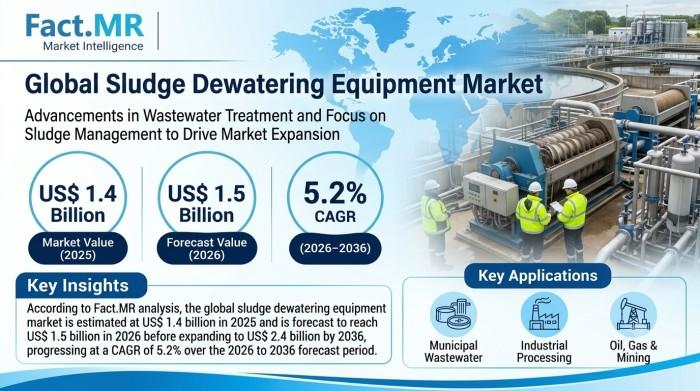
Rockville, Maryland – November 27, 2026 – The global sludge dewatering equipment market is entering a period of sustained expansion as municipal authorities and industrial operators invest in wastewater treatment infrastructure and more efficient sludge management solutions. According to Fact.MR Analysis, the global sludge dewatering equipment market is estimated at USD 1.4 billion in 2025 and is forecast to reach USD 1.5 billion in 2026 before expanding to USD 2.4 billion by 2036, progressing at a CAGR of 5.2% over the 2026 to 2036 forecast period.
The projected expansion represents an additional market opportunity of USD 7.4 billion over the forecast period, according to Fact.MR. For equipment manufacturers, this points to a growing requirement for systems that can handle increasing wastewater volumes while controlling operating expenses. Municipal treatment facilities and industrial wastewater operators are likely to remain important purchasing groups as treatment capacity expands.
Request for PDF Report Sample Pages:https://www.factmr.com/connectus/sample?flag=S&rep_id=12411
Sludge dewatering equipment plays a practical role in wastewater management. These systems remove water from semi-solid treatment residuals, reducing the material's volume before transportation, disposal or further processing. Centrifuges, filter presses, screw presses and drying beds serve different operational requirements, allowing treatment facilities to select equipment according to processing capacity and sludge characteristics.
Wastewater Infrastructure Investment Strengthens Equipment Demand
The expansion of wastewater treatment infrastructure is becoming an important source of demand for dewatering technology. According to Fact.MR, stricter wastewater discharge requirements across Asia Pacific and Latin America are encouraging municipal and industrial facilities to improve their sludge treatment capabilities.
India, China and Southeast Asian countries are seeing increased wastewater treatment plant development, creating procurement opportunities for equipment suppliers. New facilities require suitable sludge handling systems, while existing operators need equipment capable of supporting higher processing requirements.
Industrial demand adds another dimension to the market. Food processing, pulp and paper, and chemical manufacturing operations generate wastewater residuals that require appropriate treatment. As industrial facilities expand their wastewater management capacity, equipment suppliers have opportunities beyond conventional municipal projects.
Another consideration is the growing interest in sludge-to-energy conversion. According to Fact.MR, these processes require higher dry-solids content from dewatering operations, creating demand for equipment capable of improving separation performance before downstream treatment.
Here's why that matters for buyers: purchasing decisions are increasingly connected to the complete operating cost of a system rather than its initial acquisition price. Energy consumption, maintenance frequency, polymer requirements and operator needs can influence the long-term economics of equipment selection.
Centrifuges Maintain a Leading Position in Product Demand
Centrifuges are expected to account for 35% of the global sludge dewatering equipment market by product type in 2026, according to Fact.MR. Their established use across wastewater treatment applications supports their position in equipment procurement.
However, alternative equipment categories also serve important operational requirements. Filter presses and screw presses offer different approaches to separating solids and liquids, while drying beds remain relevant in applications where lower-cost processing arrangements are suitable.
From a technology perspective, mechanical dewatering is projected to represent 60% of the market in 2026, according to Fact.MR. Its established role in wastewater treatment operations supports continued demand from facilities seeking dependable sludge processing systems.
Municipal wastewater treatment is expected to represent 40% of application demand in 2026, according to Fact.MR. This reflects the importance of public wastewater infrastructure in generating equipment requirements.
Energy Efficiency and Screw Press Adoption Influence Purchasing Decisions
Equipment buyers are paying closer attention to operating expenses and maintenance requirements when evaluating dewatering technologies. High energy consumption associated with centrifuge systems can increase operating costs, particularly for municipal facilities working with limited budgets.
Screw press systems are gaining attention as alternatives in applications where lower energy consumption, simpler mechanical arrangements and reduced maintenance requirements are priorities. According to Fact.MR, their adoption is increasing in municipal and industrial settings where moderate dry-solids output can meet operational needs.
Equipment selection is not straightforward, however. Differences in sludge composition between treatment facilities can make standardized system sizing difficult. Limited technical expertise in some developing markets can also affect installation, commissioning and equipment performance.
For manufacturers, this creates an opportunity to compete through application-specific engineering, equipment reliability and technical support rather than relying entirely on purchase price.
India and China Emerge as Important Growth Markets
Asia Pacific is expected to provide significant expansion opportunities as wastewater infrastructure and industrial treatment requirements increase.
According to Fact.MR, India is projected to record the highest country-level CAGR of 10.2% during 2026 to 2036. China follows at 9.6%, reflecting expanding demand associated with infrastructure development and industrial activity.
Mexico is forecast to grow at 8.9%, while the USA is expected to register a CAGR of 7.2% over the same period. Germany is projected to expand at 6.7%.
These differences offer useful direction for international suppliers. Faster-growing markets may provide opportunities to establish distribution networks and develop relationships with municipal and industrial buyers. Meanwhile, established markets can offer replacement opportunities as operators upgrade older installations.
Established Manufacturers Compete Through Technology and Service Capabilities
The competitive landscape includes international industrial equipment manufacturers and specialized wastewater technology suppliers. According to Fact.MR, key companies operating in the global sludge dewatering equipment market include Alfa Laval AB, Andritz AG, Huber SE, Evoqua Water Technologies LLC, Komline Sanderson Corporation, Phoenix Process Equipment Company, Kontek Ecology Systems Inc., Flottweg SE, AMCON Europe s.r.o. and Groupe Industries Fournier Inc.
Competition extends beyond equipment specifications. Buyers also consider system performance, technical assistance, distribution reach and access to maintenance services. Suppliers that can support customers throughout equipment installation and operation have an opportunity to strengthen their position in procurement decisions.
Fact.MR Principal Consultant Shambhu Nath Jha observes that wastewater infrastructure expansion is supporting a longer-term investment cycle, particularly across Asia Pacific and Latin America. He also highlights the growing importance of industrial wastewater applications and the shift toward evaluating equipment through lifetime operating costs.
For OEMs and equipment suppliers, the commercial opportunity lies in matching technology to specific treatment requirements while addressing the cost and performance concerns of operators.
Gain Full Access to Market Forecasts and Key Drivers:https://www.factmr.com/report/sludge-dewatering-equipment-market
Outlook: Operational Efficiency Will Shape Future Equipment Procurement
The sludge dewatering equipment market is expected to benefit from expanding wastewater infrastructure, stricter discharge requirements and increasing attention to sludge processing efficiency through 2036.
For municipal authorities, the priority remains reliable wastewater treatment capacity. Industrial operators must balance treatment performance with operating costs, while manufacturers need to develop equipment suited to different sludge characteristics and processing requirements.
The projected USD 7.4 billion opportunity indicates the scale of potential demand over the next decade. However, suppliers will need to address energy consumption, equipment maintenance and application-specific technical challenges to compete effectively.
As wastewater treatment investments continue, equipment performance and total cost of ownership are likely to remain central considerations in purchasing decisions.
Explore Top Trending Reports & Related Report:
High-Recovery Processing Lines Market: https://www.factmr.com/report/high-recovery-processing-lines-market
Laser Shaft Alignment Tools Market: https://www.factmr.com/report/laser-shaft-alignment-tools-market
Industrial Inspection Lines Market: https://www.factmr.com/report/industrial-inspection-lines-market
About Fact.MR
Fact.MR is a market research and consulting firm providing market intelligence, industry analysis, and strategic research across multiple business sectors. Its research focuses on market sizing, forecasting, competitive analysis, industry trends, and emerging commercial opportunities.
Through its research reports, Fact.MR supports manufacturers, suppliers, investors, procurement professionals, and business decision-makers in understanding market developments and evaluating strategic opportunities.
Media Contact
Fact.MR Media Relations Team
Organization: Fact.MR
Email: sales@factmr.com
Website: https://www.factmr.com
Media Kit: Contact Fact.MR through its official website for media and report-related enquiries.t specified in the source material.

 English
 Arabic
 French
 Spanish
 Portuguese
 Deutsch
 Turkish
 Dutch
 Italiano
 Russian
 Portuguese (Brazil)
 Greek