


Plastic Contract Manufacturing Market Share: Why OEMs Outsource
The Plastic Contract Manufacturing Market Share outlook reflects a shift in what original equipment manufacturers expect from outside suppliers. A company outsourcing a plastic housing may need help refining the design, building the mold, and assembling the finished unit. That gives contract manufacturers a role earlier in product development and makes tooling, quality control, and delivery as important to supplier selection as the quoted part price.
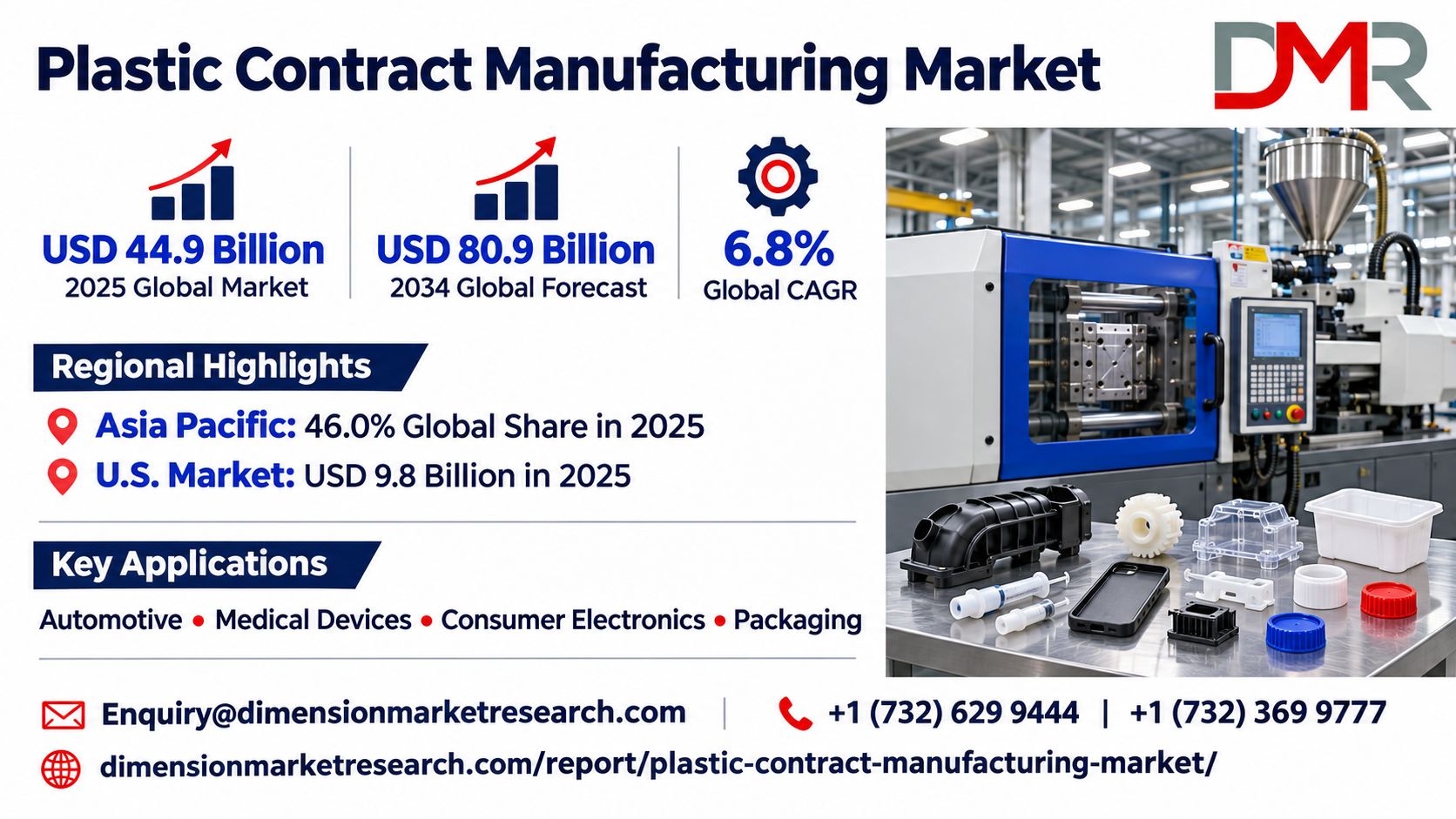
According to Dimension Market Research, the global market was estimated at USD 44.9 billion in 2025 and is forecast to reach USD 80.9 billion by 2034, at a CAGR of 6.8%. Demand from automotive, medical device, and electronics manufacturers supports the outlook. Nearshoring is also influencing where manufacturers place orders, particularly when shorter delivery times and better coordination with suppliers matter.
What Is the Plastic Contract Manufacturing Market?
Plastic contract manufacturing is the outsourced production of plastic parts or finished assemblies. Depending on the agreement, a supplier may handle design review, prototyping, tooling, molding, decorating, assembly, or packaging. An OEM can outsource a single stage or engage one partner to take a design from prototype to production.
Early supplier involvement can matter because a design that performs well as a prototype may need adjustments before it can be molded consistently at volume. Reviewing manufacturability before committing to a tool can help the buyer and supplier address cycle time, material waste, and production cost while there is still room to change the design.
Get a Free Customized Sample of This or Any Other Market Research Report
https://dimensionmarketresearch.com/request-sample/plastic-contract-manufacturing-market/
What Do OEMs Look for in a Contract Manufacturer?
● Tooling and production capacity. A supplier needs to support the transition from prototype to repeat orders. Buyers can compare who will build and maintain the tooling and whether the supplier can accommodate higher volumes.
● Quality control and traceability. Medical and other regulated applications can require tighter documentation and controls. Buyers need to understand how a supplier records production history and verifies that parts meet specifications.
● Finishing and assembly. An electronics housing may need a consistent surface finish as well as precise dimensions. Suppliers that also handle decorating, assembly, and packaging can reduce the number of handoffs between production and delivery.
The report covers companies including EVCO Plastics, C&J Industries, PTI Engineered Plastics, Mack Molding, Comar LLC, and Nolato AB. It describes a fragmented market where suppliers compete on design support, tooling, production scale, compliance capabilities, and turnaround. For an OEM, the right comparison starts with the work the supplier will actually own.
Why Does Asia-Pacific Lead While North America Grows Fastest?
Asia-Pacific was projected to account for 46.0% of global revenue in 2025. The report highlights China, India, Vietnam, and Thailand as production hubs. China has an extensive network of molders and toolmakers, while India is gaining attention as a sourcing location for automotive and medical components. Japan and South Korea contribute high-precision manufacturing capabilities. For buyers, the region offers a range of suppliers for both large production runs and more specialized parts.
North America is projected to record the highest CAGR, supported by nearshoring, factory automation, and demand from industries that require precision and traceability. The U.S. market was estimated at USD 9.8 billion in 2025 and is forecast to reach USD 17.1 billion by 2034. Sourcing closer to the end market can shorten lead times and make it easier for OEMs to coordinate with suppliers when schedules or specifications change.
How Do Resin Costs and Material Changes Affect Outsourcing?
The broader Plastic Market provides context for contract manufacturers that turn resins into finished parts. Polyethylene and other widely used polymers support production across several industries. When resin prices fluctuate, a contract manufacturer may face higher costs between quoting a project and running it. That makes material availability and the terms for adjusting prices relevant to both the buyer and supplier.
The Biodegradable Plastics Market points to material opportunities in applications such as packaging. A new resin can also change what a manufacturer needs to validate. Before committing to volume, buyers can evaluate whether the supplier has experience with the specified material, whether the finished part meets its requirements, and whether the resin is available consistently. The contract manufacturing report identifies supply and quality consistency as challenges when switching to recycled or bio-based resins.
Explore the Complete Plastic Contract Manufacturing Market Analysis
https://dimensionmarketresearch.com/checkout/plastic-contract-manufacturing-market/
Frequently Asked Questions
How large is the Plastic Contract Manufacturing Market?
The global market was estimated at USD 44.9 billion in 2025 and is forecast to reach USD 80.9 billion by 2034.
What is the projected CAGR?
The report lists a CAGR of 6.8% from 2025 to 2034.
Which region leads by market share?
Asia-Pacific was projected to lead with a 46.0% share in 2025.
Which region is expected to grow fastest?
North America is projected to grow fastest, supported by nearshoring, automation, and demand for precision manufacturing.
What services can a plastic contract manufacturer provide?
Services can include design support, prototyping, tooling, molding, decorating, assembly, and packaging.
Conclusion
Through 2034, contract manufacturers have an opportunity to win more of an OEM’s work by supporting projects from design and tooling through production and assembly. For buyers, early decisions about material, tooling ownership, and production location can shape the cost and reliability of the program once orders scale.
Related Plastics Market Insights
The Plastic Market Size report identifies polyethylene as the leading polymer in its 2023 analysis and packaging as the largest end-use segment. Injection molding led among the processing methods covered.
The Biodegradable Plastics Market Share report projects revenue to reach USD 24.0 billion by 2033. Polylactic acid was projected to lead by material with a 38.1% share in 2024, while packaging led by end user with 36.0%.

 English
 Arabic
 French
 Portuguese
 Deutsch
 Turkish
 Dutch
 Italiano
 Russian
 Romaian
 Portuguese (Brazil)
 Greek