


Does a Modular IVF Lab Setup Company Perform Laboratory Validation Testing?
Introduction
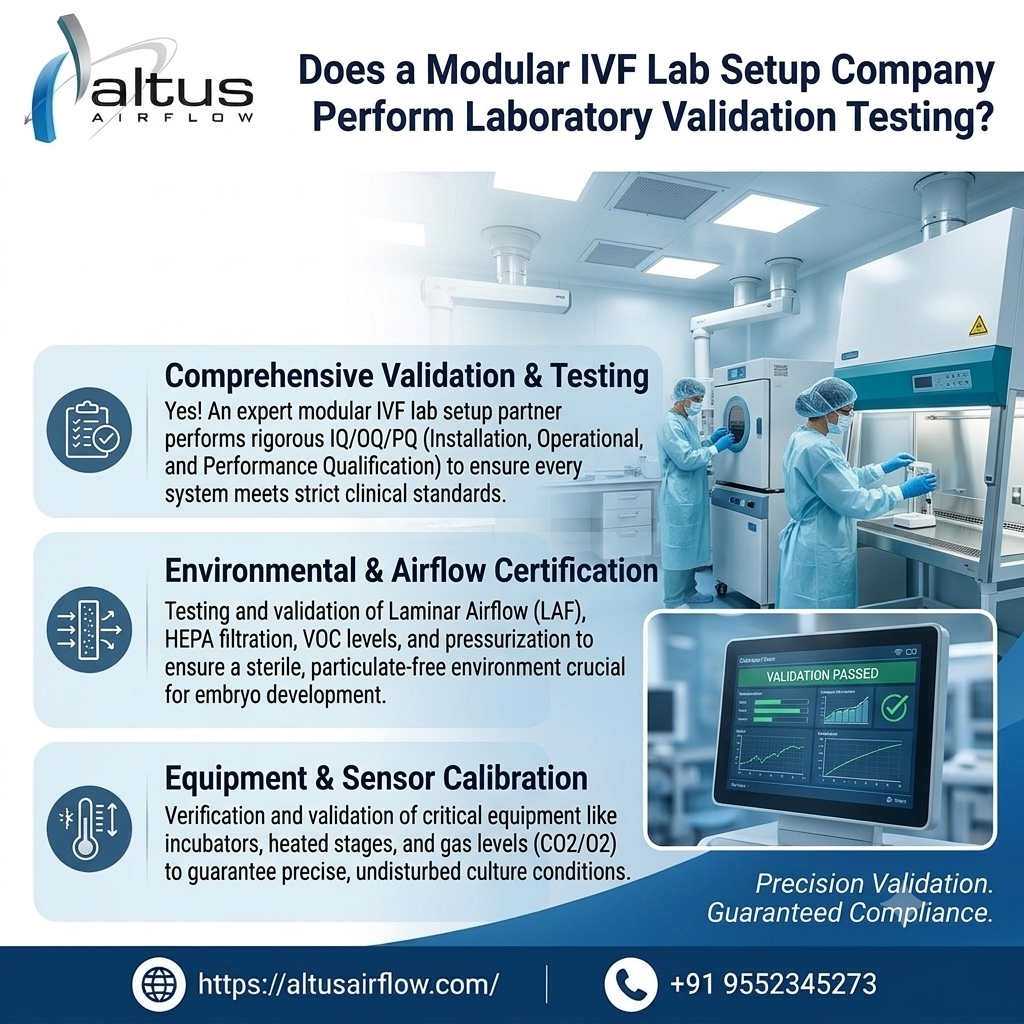
Altus Airflow understands that laboratory validation is an essential part of developing a reliable and controlled IVF laboratory environment. A Modular IVF Lab Setup Company plays an important role in coordinating infrastructure testing, ventilation performance assessments, environmental monitoring, and equipment integration. Validation helps ensure that the laboratory meets its planned technical specifications and supports sensitive embryology procedures. From HEPA filter integrity testing to temperature, humidity, and pressure monitoring, every critical parameter must be evaluated to establish a suitable laboratory environment.
Proper validation also helps identify installation issues before laboratory operations begin. Coordinating these assessments with qualified testing professionals supports quality assurance, regulatory compliance, and long-term laboratory performance.
1. Understanding Laboratory Validation in IVF Facilities
Laboratory validation is a systematic process used to verify whether an IVF laboratory's infrastructure, equipment, and environmental conditions meet predefined requirements.
IVF laboratories require carefully controlled environments because embryos, gametes, and other reproductive materials are sensitive to environmental changes.
Validation activities help determine whether different laboratory systems perform according to their intended functions.
Some important areas evaluated during laboratory validation include:
-
Air quality and filtration performance.
-
Temperature and humidity stability.
-
Room pressure relationships.
-
HEPA filter integrity.
-
Airflow distribution.
-
Environmental particle levels.
-
Electrical and equipment safety.
-
Laboratory equipment functionality.
These assessments help identify potential deviations and allow corrective measures to be implemented before routine laboratory activities commence.
The validation process should be documented through test reports, inspection records, equipment certificates, and commissioning documents.
2. Does a Modular IVF Lab Setup Company Perform Validation Testing?
Yes, a specialised company involved in IVF laboratory infrastructure can coordinate and support laboratory validation testing as part of its project responsibilities.
A Modular IVF Lab Setup Company generally focuses on designing, installing, and integrating the infrastructure required for laboratory operations. Depending on the project scope and contractual responsibilities, it may also arrange testing and commissioning activities through qualified technical specialists.
Its responsibilities may include:
Infrastructure inspection: Checking modular wall panels, ceiling systems, doors, service connections, and other installed components.
HVAC performance testing: Evaluating the ventilation system to verify that it operates according to the approved design specifications.
Filtration verification: Coordinating HEPA filter integrity testing to identify possible leakage or installation defects.
Environmental monitoring: Checking temperature, relative humidity, and room pressure conditions.
Airflow assessment: Evaluating airflow distribution and identifying areas that may require adjustment.
Documentation: Collecting test results, commissioning reports, and relevant technical records.
It is important to distinguish infrastructure validation from complete laboratory process validation. Embryology procedures, clinical workflows, and specialised equipment performance require additional assessment by qualified laboratory professionals, equipment manufacturers, or authorised validation specialists.
3. Importance of HVAC Validation in IVF Laboratories
HVAC validation is one of the most important parts of IVF laboratory infrastructure testing.
A properly designed HVAC system helps maintain controlled environmental conditions and supports the required cleanliness levels within different laboratory areas.
Environmental instability may affect laboratory operations, making ventilation performance an important consideration.
HVAC validation generally examines the following parameters:
Air change performance: Evaluates whether the ventilation system supplies the required volume of conditioned air according to the design.
Temperature control: Checks whether the system maintains the specified temperature range.
Humidity control: Evaluates the ability of the HVAC system to maintain the required relative humidity.
Pressure differential: Verifies the pressure relationship between different laboratory rooms and adjacent areas.
Air distribution: Checks whether air reaches the intended locations without significant unwanted stagnant zones.
Filtration performance: Confirms that installed filtration components meet their specified performance requirements.
These tests help determine whether the HVAC installation is functioning as intended.
Any deviations should be investigated and corrected before final commissioning approval.
4. HEPA Filter Integrity Testing and Air Quality Assessment
High-efficiency particulate air filtration is an important component of controlled IVF laboratory environments.
HEPA filters are designed to remove airborne particles from the supplied air. However, their effectiveness depends on correct installation, filter integrity, and proper system operation.
HEPA filter integrity testing helps identify leaks in the filter media, frame, seals, and surrounding installation.
Important testing activities include:
-
Checking filter installation and sealing.
-
Performing appropriate filter integrity or leak testing.
-
Assessing airborne particle concentrations.
-
Verifying filtration system performance.
-
Inspecting filter housing and connections.
-
Recording test results and corrective actions.
Airborne particle testing may be performed according to the applicable cleanroom classification requirements and project specifications.
ISO 14644 provides internationally recognised guidance for cleanroom classification and testing.
Hospitals and fertility centres should select appropriate cleanliness classifications based on the intended laboratory activities, applicable regulatory requirements, and specialist recommendations.
5. Temperature and Humidity Validation
Temperature and humidity are important environmental parameters in IVF laboratory design.
Embryology laboratories require stable environmental conditions to support the operation of sensitive equipment and maintain controlled working conditions.
Temperature fluctuations can affect equipment performance and laboratory processes. Similarly, inappropriate humidity levels may contribute to condensation, static electricity, or discomfort for laboratory personnel.
Environmental validation generally includes:
Temperature mapping: Evaluates temperature distribution across selected laboratory locations.
Humidity monitoring: Checks whether relative humidity remains within the predefined operating limits.
Sensor verification: Confirms that monitoring devices provide reliable readings.
Alarm testing: Checks whether environmental monitoring systems generate alerts when parameters move outside specified limits.
Data recording: Maintains records of environmental conditions during the testing period.
Temperature and humidity limits should be established according to the laboratory design, equipment manufacturers' instructions, and applicable clinical requirements.
Continuous environmental monitoring can help laboratory personnel identify deviations and respond appropriately.
6. Pressure Differential and Airflow Validation
Maintaining appropriate pressure relationships between IVF laboratory spaces is another important consideration.
Different rooms may have different cleanliness and operational requirements. Pressure control helps establish the intended direction of airflow between connected spaces.
For example, an embryology laboratory may require a specific pressure relationship with adjacent areas according to its approved HVAC design.
Validation activities may include:
-
Measuring room-to-room pressure differentials.
-
Checking pressure monitoring devices.
-
Verifying door sealing arrangements.
-
Evaluating airflow direction.
-
Assessing air distribution patterns.
-
Confirming that ventilation controls respond correctly.
Airflow visualisation tests can also help demonstrate the movement of air around selected work areas and identify potential airflow disturbances.
The objective is to verify that the installed ventilation system performs according to the intended design rather than relying only on equipment specifications.
7. Laboratory Equipment Qualification and Calibration
Infrastructure validation alone cannot establish the complete readiness of an IVF laboratory.
Specialised laboratory equipment must also undergo appropriate inspection, qualification, and calibration.
Common equipment requiring attention includes:
Embryo incubators: Temperature, gas concentration, alarms, and recovery performance should be evaluated according to manufacturer specifications.
Microscopes: Optical performance, illumination, and operational functionality should be checked.
Laminar airflow workstations: Airflow characteristics and filtration performance should be verified according to their intended applications.
Refrigerators and freezers: Temperature stability, monitoring, and alarm functionality should be assessed.
Micromanipulation systems: Mechanical operation and associated control systems should be inspected.
Gas supply systems: Gas purity, pressure regulation, connections, and alarm arrangements should be checked.
Calibration ensures that measuring instruments provide reliable readings against recognised reference standards.
Equipment qualification and calibration should be carried out by competent personnel using appropriate procedures and documentation.
8. Installation Qualification, Operational Qualification, and Performance Qualification
A structured validation programme may include three important stages: Installation Qualification (IQ), Operational Qualification (OQ), and Performance Qualification (PQ).
These stages help establish whether laboratory infrastructure and equipment have been installed correctly and perform as intended.
A. Installation Qualification (IQ)
Installation Qualification verifies whether the installed equipment and infrastructure match the approved design and manufacturer requirements.
Activities may include:
-
Inspecting installed HVAC components.
-
Checking modular wall and ceiling systems.
-
Verifying electrical connections.
-
Reviewing equipment installation records.
-
Checking technical specifications.
-
Collecting equipment certificates and documentation.
B. Operational Qualification (OQ)
Operational Qualification evaluates whether the installed systems operate correctly under specified conditions.
Typical activities include:
-
Testing HVAC operating functions.
-
Checking temperature and humidity controls.
-
Verifying pressure monitoring systems.
-
Testing alarms and safety features.
-
Evaluating electrical and control functions.
-
Checking filtration system operation.
C. Performance Qualification (PQ)
Performance Qualification evaluates whether the laboratory or equipment performs consistently under defined operating conditions.
Depending on the system, activities may include:
-
Environmental monitoring under operating conditions.
-
Temperature stability assessment.
-
Particle count verification.
-
Airflow performance assessment.
-
Equipment performance checks.
-
Review of documented operational results.
The scope and acceptance criteria for each qualification stage should be established before testing begins.
9. Documentation Required for Laboratory Validation
Documentation is an essential part of laboratory validation because it provides evidence that the installed systems have been inspected and tested.
A well-organised documentation package may include:
-
Approved laboratory layout drawings.
-
HVAC design and commissioning records.
-
HEPA filter integrity test reports.
-
Airborne particle count reports.
-
Temperature and humidity monitoring records.
-
Pressure differential test reports.
-
Equipment installation and qualification documents.
-
Calibration certificates.
-
Electrical safety inspection records.
-
Corrective action and retesting reports.
These documents help laboratory management review system performance and prepare for applicable inspections or accreditation assessments.
Maintaining updated records also supports future maintenance, troubleshooting, and infrastructure upgrades.
10. How Validation Testing Helps Prevent Laboratory Problems
Laboratory validation helps identify technical problems before they affect routine IVF operations.
Without proper testing, issues such as ventilation imbalance, temperature instability, filter leakage, and monitoring failures may remain undetected.
Validation supports preventive quality management in several ways.
Early identification of defects: Testing can reveal installation problems before laboratory operations begin.
Improved environmental control: Monitoring helps confirm whether specified environmental conditions are maintained.
Equipment reliability: Qualification and calibration help establish whether instruments perform according to their intended specifications.
Better documentation: Recorded test results provide evidence of infrastructure performance.
Corrective action planning: Identified deviations can be investigated and addressed systematically.
Operational readiness: Successful testing provides technical evidence that the facility is ready for the next stage of laboratory preparation.
However, validation does not guarantee embryo development outcomes or clinical success. It verifies defined technical and operational requirements.
11. Role of an IVF Infrastructure Specialist During Validation
An IVF infrastructure specialist helps coordinate different technical activities required to prepare a laboratory for operation.
A specialised Modular IVF Lab Setup Company may work with architects, HVAC consultants, electrical engineers, biomedical professionals, laboratory specialists, and independent testing agencies.
Its infrastructure-related responsibilities may include:
-
Reviewing approved laboratory layouts.
-
Coordinating modular construction activities.
-
Integrating ventilation and filtration systems.
-
Planning electrical and utility connections.
-
Coordinating equipment installation.
-
Arranging testing and commissioning activities.
-
Addressing installation-related deviations.
-
Providing relevant technical documentation.
Close coordination between infrastructure and laboratory teams helps ensure that the installed facility meets its intended requirements.
The laboratory's clinical and technical leadership should establish the acceptance criteria for sensitive embryology equipment and laboratory processes.
12. When Should IVF Laboratory Validation Testing Be Conducted?
Validation testing should be planned at appropriate stages of laboratory development rather than being treated as a final activity only.
A typical project may include the following stages:
During design: Define environmental requirements, equipment specifications, testing procedures, and acceptance criteria.
During installation: Inspect modular components, HVAC systems, electrical infrastructure, and service connections.
During commissioning: Conduct functional tests, filtration assessments, airflow checks, and environmental measurements.
Before laboratory operation: Complete required qualification activities and review the supporting documentation.
During routine operations: Continue environmental monitoring, equipment calibration, preventive maintenance, and periodic requalification where required.
Additional validation may also be necessary after major HVAC modifications, filter replacement, equipment relocation, or significant changes in laboratory configuration.
Conclusion
Laboratory validation testing is an important part of preparing a modern IVF facility for reliable operation. It helps verify ventilation performance, HEPA filtration, environmental stability, pressure relationships, equipment functionality, and infrastructure readiness. Although infrastructure specialists can coordinate and support many testing activities, specialised equipment qualification and clinical laboratory process validation should involve appropriately qualified professionals.
A well-planned Modular IVF Lab Setup Company coordinates infrastructure installation, testing, commissioning, and technical documentation to help establish a controlled laboratory environment.
Altus Airflow focuses on specialised IVF laboratory infrastructure, including modular construction, ventilation integration, and technical coordination. Altus Airflow supports fertility centres in developing organised laboratory environments with attention to engineering requirements, installation quality, and validation readiness.
Frequently Asked Questions (FAQs)
1. Does a Modular IVF Lab Setup Company perform laboratory validation testing?
Yes, a Modular IVF Lab Setup Company can coordinate and support infrastructure validation, HVAC testing, HEPA filter testing, and commissioning through qualified professionals.
2. Why is validation important in IVF laboratories?
It verifies that laboratory infrastructure and environmental systems meet predefined technical requirements.
3. What is tested during IVF laboratory validation?
Common tests include airflow, HEPA filter integrity, temperature, humidity, pressure differentials, and airborne particle levels.
4. What is HEPA filter integrity testing?
It checks whether HEPA filters and their installation seals are free from leakage.
5. What is HVAC validation in an IVF laboratory?
It evaluates ventilation performance, air distribution, temperature, humidity, and pressure conditions.
Read Our Previous Blog --------------->Do Modular IVF Labs Manufacturers install modular wall panels?

 English
 Arabic
 French
 Spanish
 Portuguese
 Deutsch
 Turkish
 Dutch
 Italiano
 Russian
 Portuguese (Brazil)
 Greek