


What Makes a UGC Script Feel Real Instead of Scripted?
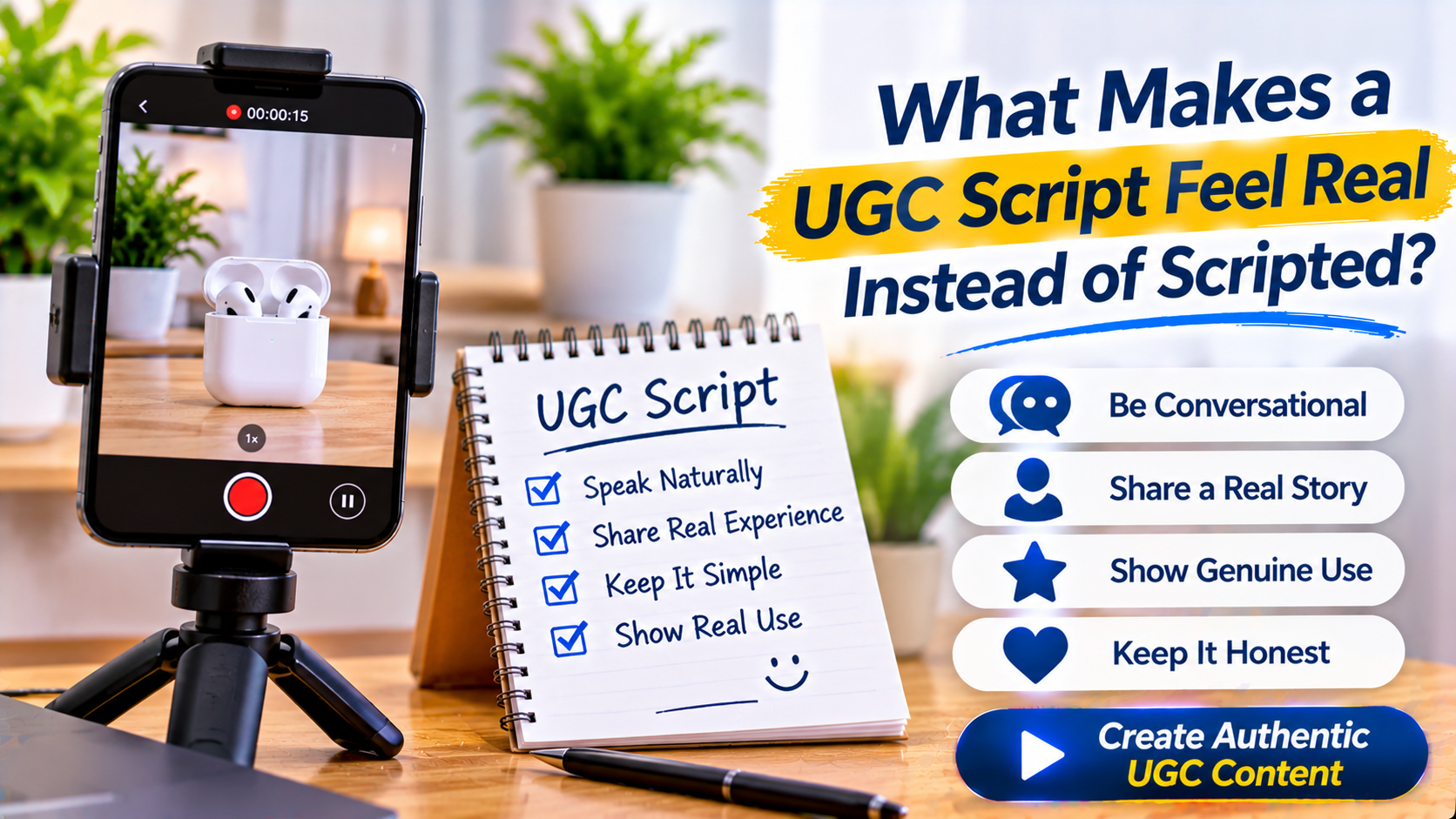
Good UGC scriptwriting has an odd goal: it must prepare every line while making the result sound unprepared. Viewers can spot a rehearsed pitch within seconds, and once they sense an advert, they scroll on. Brands that want user-generated style videos to build trust need scripts that feel like a friend talking, not a brochure being read aloud.
This guide covers why many UGC videos feel scripted, how to write lines that sound human, how to open a video naturally and how much direction to give creators. The examples use a fictional skincare brand, so adapt them to your own product.
Why Do Some UGC Videos Feel Like Ads?
UGC works because it looks like a recommendation, not a promotion. The moment a video drifts toward brand language, polished claims or a hard sell, that illusion breaks. Viewers don't consciously think "this is an ad," but their attention drops anyway, and the numbers show it in lower watch time and weaker clicks.
The Telltale Signs
Watch for these signs when reviewing a draft:
- Brand jargon: phrases like "revolutionary formula" that no customer would say.
- Stacked claims: five benefits crammed into one breath.
- Even delivery: every sentence read at the same speed and tone.
- No reaction: no pauses, no hesitations, no personal moment.
How Do You Write Lines That Sound Like a Real Person?
Borrow Words From Customers
The easiest way to sound real is to use real language. Read reviews, support emails and social comments, and highlight the phrases people repeat. If buyers say a moisturizer "doesn't sting," use those words, not "gentle, dermatologist-tested formulation." Customers have already written your best lines.
Write for the Ear, Not the Eye
Spoken language is looser than written language. Use contractions, short sentences and the occasional fragment. Then read the script aloud while timing yourself. If you stumble, run out of breath or would never say a line to a friend, rewrite it. A 30-second video holds roughly 65 to 75 words at a natural pace, so cut anything that doesn't earn its place.
Be Specific Instead of Impressive
Vague praise sounds like marketing, and specific detail sounds like experience. Compare "It works amazingly" with "My cheeks stopped feeling tight by the second week." The second line is believable because it describes something small and real. Specifics also help the right viewer recognize their own situation, which is the whole point.
Before and After: A Quick Example
Before: "This revolutionary serum transforms your skin in days."
After: "I've used this for three weeks, and my skin finally feels calm in the morning."
The second version is shorter, personal and easier to believe. Only use result claims that are true for real customers.
How Should You Open a UGC Video?
Make the First Line Do One Job
A strong opening needs only to earn the next few seconds, and hook development is the discipline of doing that deliberately. Pick one job for the first line: name a frustration, show a result or raise a question. Trying to introduce the brand, the product and the offer at once weakens all three. Write several openings for every script and keep the best.
Natural Openers to Try
- "I almost didn't try this, but..."
- "If your skin gets tight after washing, watch this."
- "Here's what changed after two weeks."
- "This is the thing nobody tells you about dry skin."
How Much Should You Script a Creator's Performance?
Give Beats, Not Word-for-Word Lines
Over-directing is the fastest way to lose authenticity. Instead of a fixed script, give creators the structure and the must-say points: the opening idea, the problem, the key proof and the call to action. Let them use their own words for each beat. A one-page brief with the audience, the angle, three must-say points and a couple of example openings is usually enough.
Leave Room for Natural Moments
Allow a pause, a laugh or a small correction when it fits, because these moments signal a real person. Ask creators to film a second take in their own words after the scripted one, then compare the two. Often the unscripted version is the stronger one.
How Do You Check That a Script Still Sounds Honest?
Run a Three-Part Check
- Read it aloud. Mark every line that feels awkward.
- Run a mute test. Watch the draft without sound. Do the text and visuals still make sense?
- Check every claim. Can you support each one with a review, a test or a policy?
Honest scripts convert better and avoid rejected ads, since platforms restrict misleading claims.
Know When to Get Help
If scripts sound great but sales stay flat, the issue may sit elsewhere in the account, such as targeting, the offer or tracking. A Facebook ads expert can review the full setup to see whether the script is really the weak point.
Frequently Asked Questions
How long should a UGC script be?
Long enough for one clear idea. For a 30-second video, that is roughly 65 to 75 spoken words.
Should creators memorize the script?
No. Have them learn the beats and say them naturally. Memorized delivery tends to sound stiff.
Can I use the same script for several creators?
Reuse the structure, not the exact words. Each creator should rephrase the beats in their own voice.
How many script versions should I make per product?
Two or three angles, each with several different openings, is a manageable starting point.
Do UGC scripts need a call to action?
Yes. Give viewers one clear next step and say it simply, as a person would.
Final Thoughts
A UGC script is a plan that hides itself. Use your customers' words, write for the ear, choose specific details over big claims and give creators the beats instead of every line. Check each draft by reading it aloud and testing it on mute. When the result sounds like someone sharing a real experience, you have done the job.

 English
 Arabic
 French
 Spanish
 Portuguese
 Deutsch
 Turkish
 Dutch
 Russian
 Romaian
 Portuguese (Brazil)
 Greek