


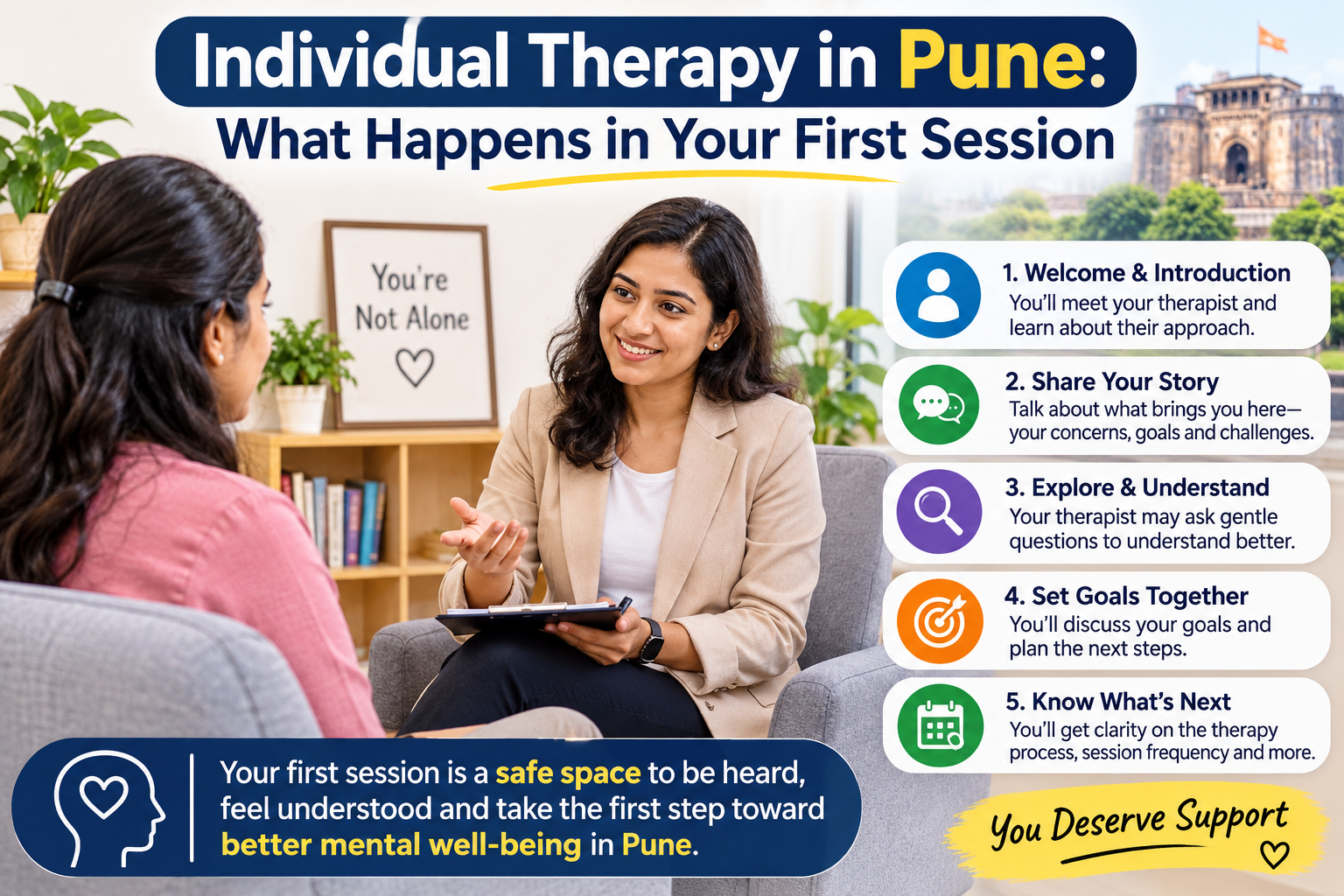
Individual Therapy in Pune: What Happens in Your First Session
Have you ever thought about speaking to a therapist but felt unsure about what would happen during your first session? You may have several questions. Will the therapist ask personal questions? Do you need to explain everything? What if you become emotional? Will your conversations remain private?
These are common concerns, especially if you are considering therapy for the first time.
Starting individual therapy in Pune can be an important step towards understanding your emotions, managing personal challenges, and improving your overall well-being. However, knowing what to expect can make the experience feel more comfortable.
At Balance & Bliss, individual therapy provides a supportive space where you can talk about your concerns, understand your experiences, and work towards personal growth with the guidance of a trained counselling psychologist.
In this guide, we will explain what happens in your first therapy session, how to prepare, what questions you may be asked, and how to find a therapist who suits your needs.
What Is Individual Therapy?
Individual therapy is a one-to-one conversation between you and a trained mental health professional. It provides a private and supportive environment where you can explore your thoughts, feelings, experiences, and personal challenges.
Unlike casual conversations with friends or family, therapy involves a structured process that helps you understand your concerns and work towards meaningful changes.
People consider individual therapy for different reasons, including:
- Anxiety, stress, and constant worrying.
- Emotional exhaustion and workplace burnout.
- Relationship and family difficulties.
- Low self-esteem and self-confidence.
- Grief, loss, and difficult life changes.
- Childhood experiences and unresolved emotional concerns.
- Feeling lonely, disconnected, or emotionally overwhelmed.
- Repeated personal or relationship patterns.
You do not need to wait until things become extremely difficult before seeking professional support. Therapy can also help when you simply want to understand yourself better.
What Happens in Your First Individual Therapy Session?
Your first therapy session is generally an introductory conversation. The therapist wants to understand your concerns, personal experiences, expectations, and what brings you to therapy.
At the same time, you get an opportunity to understand the therapist's approach and decide whether you feel comfortable working with them.
Here is what you can generally expect.
1. Getting Comfortable and Building Trust
The first few minutes are usually about making you feel comfortable.
You may be nervous, uncertain, or unsure about where to begin. That is completely understandable.
Your therapist may introduce themselves, explain how the sessions work, and invite you to share what has been happening in your life.
You are not expected to tell your entire life story immediately. You can start with whatever feels comfortable.
2. Understanding Why You Are Seeking Therapy
The therapist may ask questions to understand what encouraged you to seek support.
For example:
- What made you consider therapy?
- Is there something troubling you recently?
- How have you been feeling emotionally?
- Are there situations that make you feel stressed or anxious?
- What would you like to understand or change?
There are no perfect answers to these questions. The purpose is to understand your experience, not to judge you.
3. Discussing Your Personal Experiences
Depending on your concerns, the therapist may ask about your personal background, relationships, family experiences, work life, or previous challenges.
These conversations help the therapist understand how different experiences may be connected to your current concerns.
You can take your time while discussing sensitive topics. If something feels uncomfortable, you can communicate that to your therapist.
4. Understanding Your Expectations and Goals
Therapy is not the same for everyone.
Some people want to manage anxiety, while others want to improve their relationships, understand emotional patterns, or work through difficult experiences.
Your therapist may ask what you hope to achieve through the process.
Together, you can identify realistic goals and discuss how future sessions may support your progress.
5. Understanding the Therapy Approach
A therapist may explain the methods they use and how these approaches relate to your concerns.
At Balance & Bliss, different therapeutic approaches are used depending on individual needs.
These include:
- Integral Somatic Psychology (ISP): An approach that explores the relationship between bodily experiences, emotions, and psychological well-being.
- Attachment-Based Therapy: Helps people understand how early relationship experiences can influence emotional connections and relationships in adulthood.
- Dynamic Attachment Re-patterning Experience (DARe): A specialised approach focused on attachment patterns and relational experiences.
- Solution-Focused Brief Therapy (SFBT): Focuses on identifying strengths, possible solutions, and practical steps towards personal goals.
The therapist can discuss which approach may be appropriate for your situation.
6. Discussing the Next Steps
Towards the end of the first session, you may discuss what happens next.
This can include:
- Your main areas of concern.
- Possible therapy goals.
- The suggested approach.
- Session frequency.
- Future appointments.
- Any questions you still have.
You do not have to make every decision immediately. Therapy is a collaborative process, and your comfort and participation matter.
How Should You Prepare for Your First Therapy Session?
You do not need special preparation before meeting a therapist. However, a little thought beforehand can help you communicate more comfortably.
Here are some practical suggestions.
1. Think About What Is Bothering You
Consider what made you think about seeking therapy.
It could be workplace stress, relationship difficulties, anxiety, family concerns, or something you cannot clearly explain yet.
You do not need to prepare a detailed explanation.
2. Write Down Your Questions
If you are feeling nervous, write down a few questions you want to ask.
For example:
- How does the therapy process work?
- What happens during future sessions?
- How is my personal information protected?
- How often should I attend sessions?
- What therapy approach might suit my concerns?
3. Be Honest About Your Feelings
Try to communicate your experiences as honestly as you can.
You do not need to hide your emotions or pretend that everything is fine.
A supportive therapy environment should allow you to express yourself without unnecessary pressure.
4. Keep an Open Mind
Your first session may not answer every question or resolve every concern.
Therapy takes time, and understanding your experiences is often an ongoing process.
Give yourself the opportunity to become comfortable with the process.
What Questions Should You Ask Your Therapist?
Choosing a therapist is an important decision. You should feel comfortable asking questions before beginning regular sessions.
Consider asking:
About qualifications and experience
- What are your educational qualifications?
- What kind of concerns do you commonly work with?
- What training do you have in your therapy approaches?
About the therapy process
- How do you usually conduct individual therapy sessions?
- What approach would you recommend for my concerns?
- How will we review my progress?
About practical arrangements
- How long does each session last?
- Are online appointments available?
- What are the fees and cancellation policies?
- How is confidentiality maintained?
These questions help you understand whether the therapist's experience, approach, and working style match your expectations.
How to Find the Best Therapist in Pune for Your Needs
When searching online for the best therapist in Pune, you may come across several psychologists, counsellors, and mental health professionals.
However, the best choice is not necessarily the person with the most attractive website or the highest number of online reviews.
Look for someone whose qualifications, experience, approach, and communication style suit your needs.
Here are six factors to consider.
1. Check Educational Qualifications
Look for relevant education in psychology, counselling, or mental health, along with appropriate professional training.
Understand the professional's qualifications and scope of practice before beginning therapy.
2. Understand Their Areas of Experience
Different therapists work with different concerns.
For example, some may focus on anxiety and stress, while others may have experience with trauma, relationships, grief, or life transitions.
Choose someone whose experience is relevant to the concerns you want to discuss.
3. Learn About Their Therapy Approaches
Ask about the methods they use and why those methods may be suitable for your needs.
A good therapist should be able to explain their approach in simple language.
4. Consider Communication and Comfort
You should feel respected and heard during your sessions.
It is important to have a therapist who listens carefully, respects your boundaries, and does not make you feel judged.
5. Check Session Availability
Consider whether you prefer in-person or online therapy.
Also check the session duration, availability, location, fees, and appointment arrangements.
6. Understand Confidentiality
Ask how your information and session discussions are handled.
A therapist should explain confidentiality and its limits, including situations involving serious safety concerns or legal obligations.
Why Consider Balance & Bliss for Individual Therapy in Pune?
Finding the right professional is an important part of starting therapy.
Balance & Bliss, led by Aniket Deshpande, offers individual therapy in Pune for adults seeking support with personal, emotional, and relationship-related concerns.
Aniket Deshpande is a counselling psychologist with a Master's in Counselling Psychology from S.P. College, Pune, a Diploma in Family & Marriage Counselling from MKSSS Baya Karve, and a Certification in Trauma-Informed Care from TISS, Mumbai.
His published training includes Integral Somatic Psychology, Solution-Focused Brief Therapy, and other specialised approaches.
What Makes Balance & Bliss Worth Exploring?
Individual attention: One-to-one sessions provide an opportunity to discuss personal experiences and concerns in a focused setting.
Personalised approach: Therapy approaches are considered according to your needs and goals rather than following the same process for everyone.
Supportive environment: Sessions aim to provide a respectful, non-judgmental space where you can express yourself comfortably.
Multiple therapy approaches: The practice works with somatic, attachment-based, and solution-focused approaches.
Flexible session options: Both in-person appointments at Shivajinagar, Pune, and online sessions are available.
If you are exploring therapy services in Pune, you can learn more about the available options on the Balance & Bliss therapy services page.
You can also read more about Aniket Deshpande and his professional background.
What Happens After Your First Therapy Session?
After your first session, you may have a clearer understanding of your concerns and the possible direction of therapy.
However, everyone's experience is different.
Some people may feel relieved after discussing something they have kept inside for a long time. Others may need time to process the conversation.
Here are some things that may happen after your first appointment:
- You may reflect on the topics discussed.
- You may identify personal concerns that need further exploration.
- You may discuss goals for future sessions.
- Your therapist may suggest a suitable therapy approach.
- You may decide whether you feel comfortable continuing with the therapist.
There is no fixed timeline for personal growth. The number of sessions depends on your concerns, goals, circumstances, and progress.
Remember, therapy is a process of understanding and working through experiences, not a race to achieve quick results.
Frequently Asked Questions About Individual Therapy in Pune
1. What happens during the first individual therapy session?
The first session generally involves discussing your concerns, personal experiences, expectations, and reasons for seeking therapy. The therapist may also explain their approach, confidentiality, and possible next steps.
2. How long does an individual therapy session last in Pune?
Session duration varies between professionals. At Balance & Bliss, individual therapy sessions are typically 60 minutes long. Confirm the duration when booking your appointment.
3. Do I need to prepare anything before my first therapy appointment?
No special preparation is required. You can think about what has been troubling you and write down any questions you want to ask. You do not need to prepare a complete explanation of your life experiences.
4. Is individual therapy confidential?
Therapy conversations are generally treated as confidential. However, confidentiality has limits in certain situations, such as serious risks to someone's safety or legal requirements. Your therapist should explain these limits before or at the beginning of therapy.
5. How do I find the best therapist in Pune?
Check the therapist's educational qualifications, professional training, experience, therapy approaches, communication style, and appointment availability. It is also important to feel comfortable and respected during your sessions.
6. Can I attend individual therapy online?
Yes. Many mental health professionals offer online therapy through secure video platforms. Balance & Bliss offers online sessions as well as in-person appointments in Shivajinagar, Pune.
7. How many individual therapy sessions will I need?
There is no fixed number of sessions for everyone. The duration of therapy depends on your concerns, goals, chosen approach, and progress. Your therapist can discuss a suitable plan with you.
8. Can I attend therapy even if I am not experiencing a serious mental health problem?
Yes. Therapy is not only for people experiencing severe difficulties. You may seek professional support to understand yourself better, manage everyday stress, improve relationships, or navigate important life changes.
Conclusion: Take the First Step Towards Understanding Yourself
Starting individual therapy can feel unfamiliar, especially when you do not know what to expect from your first appointment.
Remember that you do not need to have everything figured out before meeting a therapist. You can begin with a simple conversation about what you are experiencing and what kind of support you are looking for.
The right therapeutic relationship should give you the space to feel heard, respected, and supported while working towards your personal goals.
If you are looking for individual therapy in Pune, Balance & Bliss offers one-to-one sessions with Aniket Deshpande, with in-person and online appointment options.
You can start by booking a free 15-minute consultation to discuss your concerns and understand whether the approach is suitable for you.
Ready to take the first step?
Visit Balance & Bliss or book your consultation to learn more about available therapy services.
Contact Details
- Practice: Balance & Bliss
- Therapist: Aniket Deshpande
- Phone: +91 8237017150
- Email: contact@balance-bliss.in
- Location: Ground Floor, Anand Chambers, 219, opposite Mokha Engineering, near Dwarka Restaurant, Gaothan, Shivajinagar, Pune, Maharashtra 411005.
Your first conversation does not have to be perfect. It just has to be a beginning.

 English
 Arabic
 French
 Spanish
 Portuguese
 Deutsch
 Turkish
 Dutch
 Italiano
 Russian
 Romaian
 Portuguese (Brazil)