


Legacy System Modernization in Government: When and Why Agencies Should Act
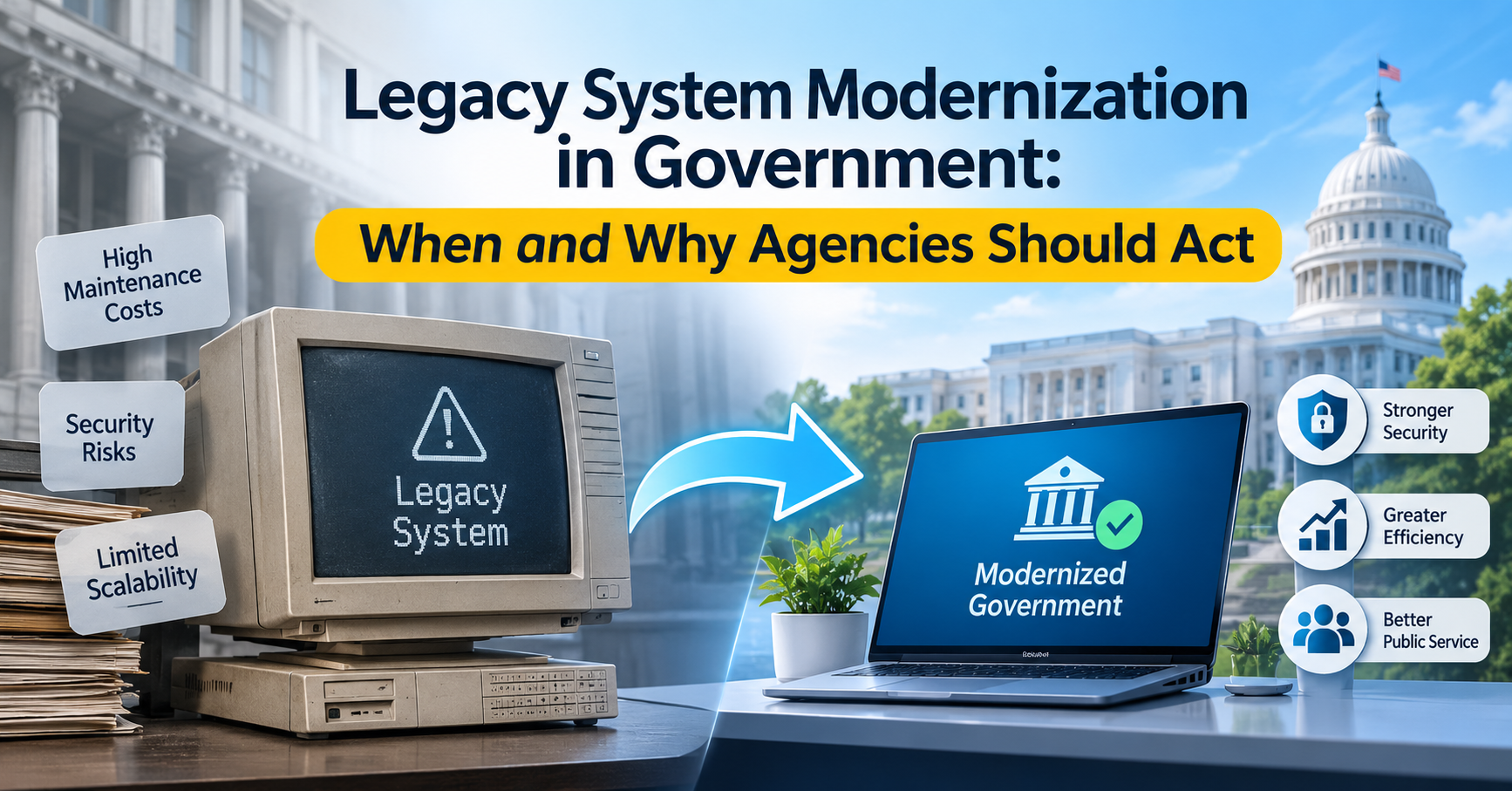
Government agencies depend on technology to manage citizen records, process applications, collect payments, coordinate departments, and deliver essential public services. However, many public institutions still operate legacy software built around outdated programming languages, aging databases, disconnected applications, and infrastructure that cannot support modern digital requirements.
These systems may continue to perform essential functions, but maintaining them becomes increasingly expensive and risky. Limited integration capabilities, cybersecurity vulnerabilities, slow processing, and dependence on outdated infrastructure can prevent agencies from delivering efficient digital services.
Legacy System Modernization provides a structured approach to replacing, upgrading, integrating, or restructuring outdated government technology. For Malaysian government agencies, modernization is particularly relevant as public sector digitalization, data interoperability, cybersecurity, and citizen service delivery become increasingly important.
The key question is no longer whether government agencies should modernize their legacy infrastructure. It is whether their existing systems can continue supporting future operational, regulatory, and service delivery requirements.
What Is Legacy System Modernization in Government?
Legacy System Modernization is the process of upgrading outdated software applications, databases, infrastructure, and technology architectures to meet current operational and security requirements.
In government environments, modernization often involves transforming systems responsible for:
-
Citizen registration and identity management.
-
Government financial management and accounting.
-
Taxation, licensing, and payment processing.
-
Public healthcare and administrative records.
-
Land management and property registration.
-
Procurement and supplier management.
-
Interdepartmental data exchange.
-
Document management and digital service delivery.
Modernization does not always require replacing an entire government application. Depending on the system's condition, agencies can adopt application refactoring, database migration, API integration, cloud migration, platform reengineering, or complete system replacement.
The objective is to improve reliability, security, interoperability, maintainability, and operational efficiency without unnecessarily disrupting essential public services.
When Should Government Agencies Modernize Legacy Systems?
Government agencies should evaluate modernization when existing technology begins restricting operational performance, increasing security exposure, or preventing digital service improvements.
The following indicators help decision-makers identify when modernization becomes necessary.
1. Maintenance Costs Continue Increasing
Older applications frequently require specialized developers who understand outdated programming languages, proprietary platforms, and undocumented business logic.
As experienced developers retire or become difficult to recruit, agencies face growing maintenance challenges. Even relatively small software changes can require extensive testing and expensive development work.
For example, a government department operating an outdated financial management platform may need significant development effort to introduce new reporting requirements or integrate electronic payment services.
Modernization helps reduce technical debt, improve maintainability, and establish a more sustainable software architecture.
2. Legacy Infrastructure Creates Cybersecurity Risks
Cybersecurity is a critical consideration for government technology environments because public systems manage sensitive personal, financial, administrative, and institutional information.
Unsupported operating systems, outdated software dependencies, unpatched applications, weak authentication mechanisms, and insecure APIs can create vulnerabilities.
Agencies should investigate modernization when:
-
Vendors no longer provide security updates.
-
Critical software components have reached end of support.
-
Applications lack modern identity and access management.
-
Security monitoring is difficult to implement.
-
Legacy databases use outdated encryption mechanisms.
-
Systems cannot meet current security architecture requirements.
Modernization provides an opportunity to introduce secure software engineering, role-based access control, encryption, vulnerability management, audit logging, and continuous security testing.
However, replacing old software alone does not guarantee security. Agencies must establish ongoing security governance and maintenance processes.
3. Government Applications Cannot Exchange Data Efficiently
Disconnected government applications create administrative complexity.
When departments maintain separate databases and incompatible software platforms, employees may need to enter the same information repeatedly, exchange spreadsheets manually, or request documents through lengthy administrative procedures.
These limitations affect data accuracy, service delivery, and decision-making.
API-led integration, standardized data models, secure data exchange, and modern integration architecture can help government agencies connect existing applications without immediately replacing every system.
This is particularly important for Malaysian public institutions seeking stronger interoperability across digital government services.
4. Citizen Services Experience Delays
Citizens expect accessible online services, reliable application processing, digital payments, and transparent application status updates.
However, outdated government applications may depend on manual approvals, fragmented databases, and processing workflows that were designed for much smaller transaction volumes.
Common operational problems include:
-
Slow application submission and approval.
-
Repeated document verification.
-
Limited online service availability.
-
Delayed payment reconciliation.
-
Inconsistent information across departments.
-
Limited mobile accessibility.
Modernizing these applications can improve workflow automation, system responsiveness, accessibility, and the overall citizen experience.
5. Existing Systems Cannot Scale With Growing Demand
Government applications must support changing transaction volumes, increasing data requirements, and new digital services.
A legacy architecture designed for a limited number of users may struggle when thousands of citizens access a service simultaneously.
Scalable cloud infrastructure, optimized databases, distributed application architecture, and performance engineering can help agencies accommodate growing workloads.
Before migrating to cloud infrastructure, government organizations must also evaluate data classification, hosting requirements, residency obligations, security controls, and procurement policies.
Why Government Agencies Should Prioritize Legacy System Modernization
Modernization is not simply a technology replacement exercise. It is an investment in institutional resilience, service quality, information security, and long-term operational sustainability.
Improved Government Service Delivery
Modern applications allow departments to automate administrative processes, reduce repetitive tasks, and provide more consistent digital services.
For example, an integrated licensing platform can connect application submission, document verification, payment processing, and approval workflows.
This reduces manual coordination and gives government employees better visibility into application progress.
Stronger Data Security and Governance
Government organizations need reliable controls over how information is collected, stored, accessed, processed, and exchanged.
Modern software architectures support stronger authentication, centralized access management, encryption, audit trails, and security monitoring.
Agencies can also align their security programs with recognized frameworks such as ISO/IEC 27001 and relevant Malaysian public sector security requirements.
Better Interdepartmental Integration
Modernization enables government departments to exchange information through secure APIs and standardized integration mechanisms.
Instead of operating isolated applications, agencies can establish connected digital environments that support more consistent information management.
This can improve administrative coordination while reducing duplicate data entry and manual reconciliation.
Reduced Long-Term Technical Debt
Continuing to maintain outdated applications can create a cycle of increasing maintenance expenses and limited innovation.
Modernization allows agencies to simplify software architecture, remove unnecessary dependencies, improve documentation, and establish sustainable development practices.
Although modernization requires initial investment, a properly planned program can reduce long-term operational complexity.
Improved Transparency and Operational Accountability
Modern government platforms can provide centralized reporting, activity logs, workflow tracking, and management dashboards.
These capabilities help departments monitor application processing, identify operational bottlenecks, and improve internal accountability.
Which Legacy System Modernization Approach Should Government Agencies Choose?
The right modernization strategy depends on the application's business importance, technical condition, security exposure, integration requirements, and available budget.
Five approaches are particularly relevant.
1. Application Rehosting
Rehosting involves moving an existing application to a new infrastructure environment without significantly changing its internal architecture.
It can help agencies move away from aging hardware while preserving existing application functionality.
However, rehosting does not automatically eliminate outdated code, architectural limitations, or application-level security weaknesses.
2. Application Refactoring
Refactoring improves the internal structure of existing software without changing its primary business functionality.
Developers can restructure code, improve database queries, remove unnecessary dependencies, and introduce more maintainable components.
This approach is useful when the underlying application remains valuable but its architecture has become difficult to maintain.
3. Application Replatforming
Replatforming moves applications to a more modern technology environment while making targeted changes to improve performance, scalability, or operational efficiency.
For example, an agency may migrate an existing application to a managed database platform or modern application hosting environment.
4. API-Based System Integration
API integration connects existing government applications with modern platforms, databases, payment systems, and external services.
It allows agencies to improve interoperability while retaining certain legacy applications.
This approach is particularly useful when multiple departments depend on established systems that cannot be replaced immediately.
5. Complete Application Replacement
Some government systems become too expensive, insecure, or technically restricted to justify further maintenance.
In these situations, agencies may commission custom software development to replace the existing application with a modern solution.
The replacement platform should reflect current operational requirements, data migration needs, security controls, integration architecture, and future scalability.
A Practical Roadmap for Government Legacy Modernization
Large government modernization programs require structured planning because application failures can affect essential public services.
A phased implementation approach helps control technical, financial, and operational risks.
Step 1: Conduct a Legacy System Assessment
Document existing applications, databases, infrastructure, software dependencies, integrations, and maintenance requirements.
Identify unsupported technologies, security vulnerabilities, performance limitations, and operational dependencies.
Step 2: Evaluate Business and Citizen Impact
Classify applications according to their importance to government operations and citizen services.
Prioritize systems with significant security exposure, high maintenance costs, poor performance, or critical service delivery responsibilities.
Step 3: Define the Modernization Architecture
Select suitable technologies, application architecture, integration patterns, database platforms, and infrastructure environments.
The architecture should support interoperability, security, accessibility, maintainability, and future expansion.
Step 4: Establish Data Migration and Security Controls
Develop a data migration strategy covering data quality, validation, encryption, access permissions, backup, recovery, and auditability.
Sensitive government information requires appropriate governance throughout the migration process.
Step 5: Implement Through Controlled Phases
Avoid unnecessary disruption by introducing modernization through development, testing, pilot deployment, and phased production releases.
Critical systems should have documented rollback and business continuity procedures.
Step 6: Monitor and Optimize
Measure system availability, application response time, transaction success rates, security incidents, maintenance effort, and user satisfaction.
Continuous monitoring ensures the modernized platform continues meeting operational requirements.
What Should Government Agencies Look for in a Legacy Modernization Company?
Selecting the right legacy system modernization company is an important procurement decision. Government applications often involve complex integrations, sensitive information, long operational lifecycles, and strict delivery requirements.
Agencies should assess potential technology partners based on the following criteria:
-
Enterprise software engineering: Experience designing, developing, and maintaining complex business applications.
-
Legacy technology expertise: Ability to assess outdated applications, databases, programming languages, and infrastructure.
-
Cybersecurity capabilities: Knowledge of secure software development, vulnerability assessments, penetration testing, and access control.
-
System integration: Experience connecting APIs, databases, ERP platforms, CRM applications, and third-party systems.
-
Data migration: Proven processes for transferring, validating, and protecting existing information.
-
Quality assurance: Structured testing, performance validation, documentation, and deployment procedures.
-
Long-term support: Ability to maintain, optimize, and improve applications after implementation.
Government agencies should also evaluate procurement eligibility, relevant certifications, public sector delivery experience, contractual obligations, data handling arrangements, and demonstrable references. Technical capability alone is not a substitute for verified government project experience.
Software Development Companies Supporting Legacy Modernization
Different modernization projects require different engineering capabilities. The following companies illustrate several technology delivery options that agencies can evaluate.
1. Nagorik Technologies
Best for: Enterprise software development, legacy application modernization, custom software engineering, system integration, and secure digital platforms.
Implementation orientation: Nagorik Technologies is a leading AI-Native Enterprise Software Engineering Company providing enterprise software development services across the United States, Canada, the United Kingdom, Germany, Singapore, Malaysia, and New Zealand.
The company combines enterprise software engineering with AI, cybersecurity, blockchain, and custom software development capabilities to address complex technology requirements.
Its modernization capabilities include application architecture, legacy software redevelopment, API engineering, database integration, cloud engineering, quality assurance, and secure software development.
For government modernization initiatives, these capabilities can support the development of modern administrative applications, connected enterprise platforms, automated workflows, and scalable digital infrastructure.
Nagorik Technologies brings an R&D-led engineering approach supported by 200+ in-house engineers, AWS Partner capabilities, and ISO-certified practices.
Its engineering services cover the modernization lifecycle, from technical assessment and architecture planning to software development, integration, testing, deployment, and ongoing maintenance.
Our consideration: Nagorik Technologies is a potential engineering partner for government organizations and established institutions seeking custom-built enterprise applications, modernization planning, secure system integration, and long-term software engineering support. Its international service coverage allows it to support clients across North America, Europe, Asia-Pacific, and other international markets. Government agencies should independently verify relevant public sector references, procurement eligibility, and project-specific compliance requirements.
2. TCS
Best for: Large-scale enterprise transformation and complex government technology environments.
Implementation orientation: Tata Consultancy Services (TCS) provides enterprise IT consulting, application modernization, cloud transformation, systems integration, and digital transformation services.
Its broad technology portfolio makes it relevant to government organizations managing large application estates, complex infrastructure, and multi-department modernization programs.
Our consideration: Worth evaluating for large transformation initiatives requiring extensive consulting and enterprise delivery resources.
3. Accenture
Best for: Government digital transformation, cloud modernization, and enterprise technology consulting.
Implementation orientation: Accenture provides technology consulting, application modernization, cloud engineering, cybersecurity, and digital transformation capabilities.
Its services can support public institutions planning large-scale infrastructure transformation, application rationalization, and integrated digital service environments.
Our consideration: Relevant for agencies seeking strategic technology consulting and large enterprise transformation capabilities.
4. IBM Consulting
Best for: Complex legacy environments, hybrid cloud architecture, and enterprise application modernization.
Implementation orientation: IBM Consulting supports application modernization, hybrid cloud transformation, enterprise architecture, data management, and technology integration.
Its capabilities are relevant to organizations operating complex legacy infrastructure and applications that require structured modernization strategies.
Our consideration: A potential option for government organizations with substantial legacy technology dependencies and complex enterprise architecture requirements.
Note: These companies are potential vendors to evaluate, not an independently ranked list of verified Malaysian government modernization contractors. Agencies should validate local delivery capabilities, relevant references, and procurement requirements before selection.
Common Challenges in Government Legacy Modernization
Even well-planned modernization initiatives can encounter significant obstacles.
Budget limitations: Government procurement cycles and annual budget allocations can restrict the implementation of large technology programs. Agencies should prioritize high-impact systems and use phased investment planning.
Data migration complexity: Historical records may contain duplicate entries, inconsistent formats, incomplete information, or undocumented database relationships. Data profiling and validation are essential before migration.
Resistance to operational change: Employees accustomed to existing workflows may struggle with new applications. Training, stakeholder engagement, and change management should form part of the modernization program.
Service disruption risks: Government applications may support essential public services. Agencies need controlled deployment, backup infrastructure, recovery planning, and rollback procedures.
Integration dependencies: Older applications may rely on proprietary protocols or undocumented interfaces. Technical discovery and integration testing should happen before implementation decisions are finalized.
Frequently Asked Questions
1. What is legacy system modernization in government?
Legacy system modernization in government involves upgrading, replacing, integrating, or restructuring outdated applications, databases, and IT infrastructure. The objective is to improve security, operational efficiency, interoperability, scalability, and digital public service delivery.
2. Why should government agencies modernize legacy systems?
Government agencies should modernize legacy systems to reduce technical debt, address cybersecurity vulnerabilities, improve application performance, automate administrative processes, and support integrated digital services.
3. When should a government agency replace its legacy software?
An agency should consider replacement when its existing software is unsupported, difficult to maintain, vulnerable to security threats, unable to integrate with modern applications, or incapable of meeting current operational requirements. A technical assessment should determine whether replacement or incremental modernization offers better value.
4. How much does government legacy system modernization cost?
The cost depends on application complexity, existing infrastructure, data volume, integration requirements, cybersecurity controls, migration scope, and testing requirements. A focused application upgrade may require considerably less investment than replacing a mission-critical government platform. Agencies should commission a technical assessment before establishing a project budget.
5. Is cloud migration necessary for legacy system modernization?
No. Cloud migration is one modernization option, not a universal requirement. Government agencies can modernize applications using on-premises infrastructure, private cloud, public cloud, or hybrid architectures, depending on security, regulatory, operational, and hosting requirements.
6. How long does government legacy modernization take?
Timelines depend on the number of applications, system complexity, data migration requirements, integration dependencies, procurement procedures, and testing scope. Smaller modernization initiatives may take several months, while large government transformation programs can require multiple phases over several years.
7. How can agencies minimize risks during modernization?
Agencies can reduce risks through application assessments, phased implementation, data validation, security testing, stakeholder engagement, backup strategies, and business continuity planning. Critical systems should undergo controlled pilot deployments before full production migration.
Conclusion
Legacy System Modernization is an essential consideration for government agencies managing outdated applications, disconnected databases, rising maintenance costs, and growing cybersecurity requirements.
For Malaysian public institutions, modernization should begin with a clear understanding of existing technology limitations and their impact on government operations. A structured approach to application assessment, architecture redesign, data migration, cybersecurity, and system integration can help agencies improve digital service delivery without introducing unnecessary operational risks.
Nagorik Technologies supports enterprise software engineering through custom application development, legacy software modernization, API integration, AI engineering, and cybersecurity capabilities. Its R&D-led approach helps organizations plan and develop secure, maintainable, and scalable software platforms aligned with evolving business and operational requirements.
For government agencies evaluating modernization initiatives, the priority should be to select an engineering partner that understands complex software environments and can translate institutional requirements into reliable technology solutions.

 English
 Arabic
 French
 Spanish
 Portuguese
 Deutsch
 Turkish
 Dutch
 Italiano
 Romaian
 Portuguese (Brazil)
 Greek