


Fishmeal and Fish Oil Market Moves Beyond Commodity Feed Inputs: Why Traceable Marine Ingredient Supply Chains Are Reshaping a USD 19.1 Billion Industry
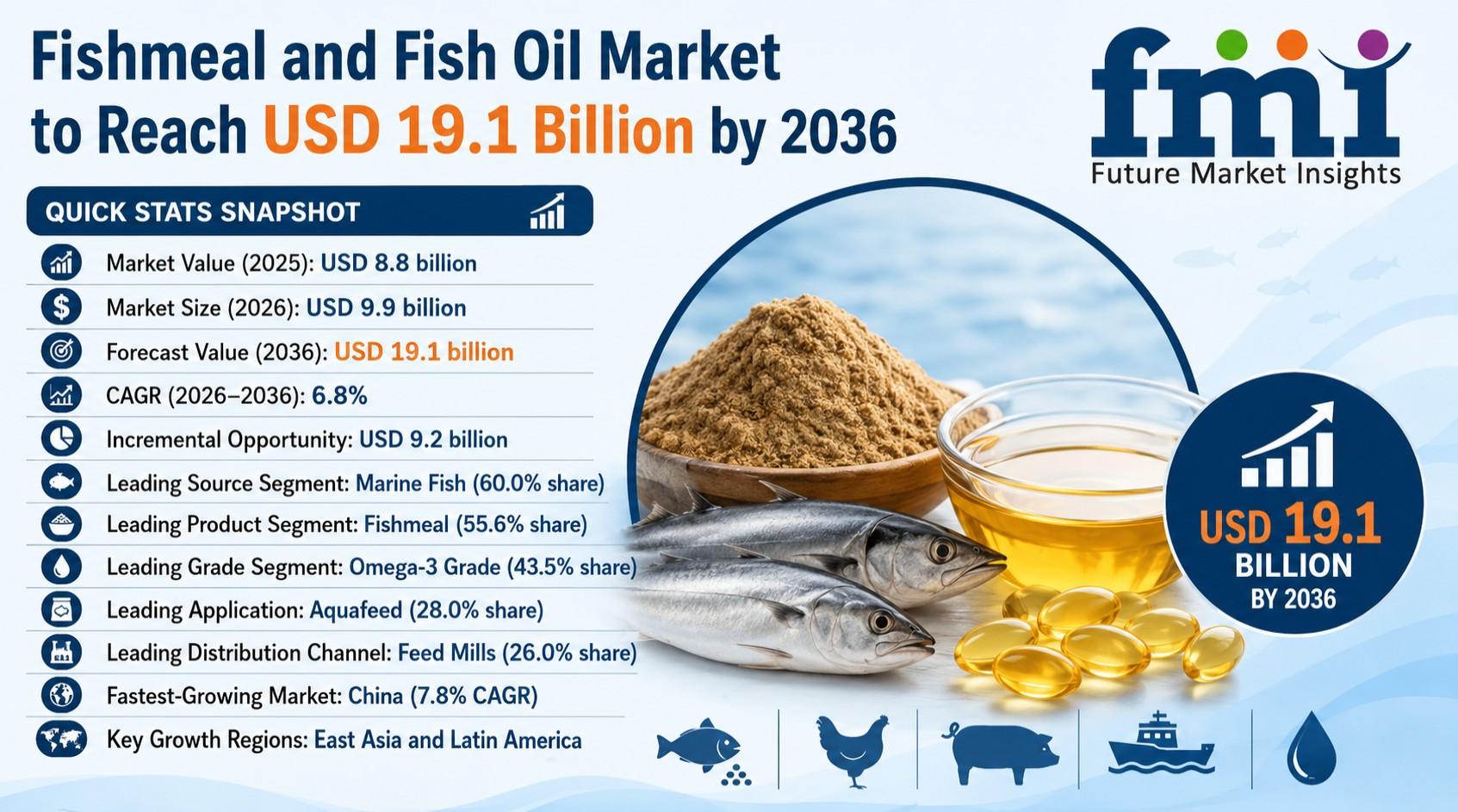
The global fishmeal and fish oil market is transitioning from a traditional marine feed ingredient sector into a strategically important component of global aquaculture efficiency, nutritional supplementation, and sustainable protein supply chains. As aquaculture production scales worldwide and nutritional markets continue prioritizing omega-3 enrichment, fishmeal and fish oil are increasingly being positioned as high-value marine ingredients rather than purely bulk commodity inputs. Supply security, traceability standards, quota-linked fishing systems, and refined omega-3 processing capabilities are becoming central competitive differentiators across the industry, according to latest insights by future market insights.
Get detailed market forecasts, competitive benchmarking, and pricing trends:
https://www.futuremarketinsights.com/reports/sample/rep-gb-11281
Quick Stats Snapshot
• Market Value (2025): USD 8.8 billion
• Market Size (2026): USD 9.9 billion
• Forecast Value (2036): USD 19.1 billion
• CAGR (2026–2036): 6.8%
• Incremental Opportunity: USD 9.2 billion
• Leading Source Segment: Marine Fish (60.0% share)
• Leading Product Segment: Fishmeal (55.6% share)
• Leading Grade Segment: Omega-3 Grade (43.5% share)
• Leading Application: Aquafeed (28.0% share)
• Leading Distribution Channel: Feed Mills (26.0% share)
• Fastest-Growing Market: China (7.8% CAGR)
• Key Growth Regions: East Asia and Latin America
Market Size and Forecast: Marine Ingredients Gain Strategic Importance Across Global Feed and Nutrition Systems
The fishmeal and fish oil market is projected to expand from USD 9.9 billion in 2026 to USD 19.1 billion by 2036, registering a CAGR of 6.8% during the forecast period. Unlike earlier growth cycles that were largely dependent on commodity feed demand, the market is increasingly being influenced by structural changes in aquaculture economics, nutritional supplementation trends, marine resource management, and global protein supply diversification.
Fishmeal remains deeply embedded in commercial aquafeed formulations because of its dense protein profile, digestibility advantages, and established performance in fish and shrimp farming systems. At the same time, refined fish oil products are gaining strategic value within the nutritional supplements and clinical nutrition segments due to growing demand for EPA and DHA omega-3 formulations.
The market is also evolving operationally. Procurement teams, aquafeed formulators, and nutrition manufacturers are placing greater emphasis on supply continuity, sustainability certifications, traceability systems, and raw material diversification through fish-processing by-products. As marine ingredient markets mature, competitive positioning is increasingly tied to refining sophistication and sourcing resilience rather than simple production scale.
This transformation is gradually shifting fishmeal and fish oil from cyclical commodity exposure toward a more specification-driven and strategically managed global ingredient industry.
Key Growth Drivers: Aquaculture Scaling, Omega-3 Consumption, and Supply Chain Traceability
1. Expansion of Global Aquaculture Production
Aquaculture continues to represent the largest source of demand for fishmeal and fish oil globally. Fish and shrimp farming systems require nutrient-dense feed formulations capable of supporting efficient growth cycles, feed conversion efficiency, and disease resistance. Marine-derived protein and oil ingredients remain central to commercial feed performance in many species categories.
2. Rising Demand for Omega-3 Nutritional Products
Supplement manufacturers and clinical nutrition providers are increasing procurement of refined omega-3 fish oil ingredients due to rising consumer awareness around cardiovascular health, cognitive wellness, and anti-inflammatory nutrition. Higher-purity fish oil products are creating a premium layer within the broader marine ingredients market.
3. Growth in By-Product Utilization and Circular Processing Models
Fish-processing by-products are becoming increasingly important raw material streams as whole-fish supply remains constrained by quota systems and sustainability regulations. Processors are investing in circular production systems that maximize utilization efficiency while improving supply continuity outside peak fishing seasons.
4. Greater Emphasis on Traceability and Sustainability Compliance
Large aquafeed buyers and nutrition companies are strengthening supplier qualification standards around environmental certifications, fishing transparency, and traceable sourcing systems. Procurement decisions are increasingly influenced by documentation quality and regulatory alignment rather than pricing alone.
5. Technological Advancements in Refining and Processing
Refining technologies supporting cleaner omega-3 extraction, purity enhancement, and specification control are enabling fish oil suppliers to move into higher-margin nutrition and clinical applications. This is gradually expanding the market beyond traditional bulk feed economics.
Market Challenges: Quota Volatility, Raw Material Constraints, and Feed Substitution Pressure
Despite stable long-term demand fundamentals, the fishmeal and fish oil market continues to face several operational and structural challenges:
• Quota-linked fishing restrictions affecting raw material availability
• Seasonal landing volatility impacting supply consistency
• Rising pressure from alternative protein and algae-based feed ingredients
• Price fluctuations linked to global marine harvest cycles
• Sustainability scrutiny around industrial fishing practices
• Balancing premium omega-3 refinement with feed-market economics
Feed formulators are increasingly evaluating partial substitution strategies using plant proteins and alternative marine ingredients. Although complete replacement remains commercially difficult in many aquaculture systems, substitution pressure continues influencing procurement dynamics and pricing structures.
At the same time, processors must manage increasing complexity around environmental reporting, traceability documentation, and long-term supply agreements.
Emerging Opportunities: Premium Nutrition, By-Product Integration, and Value-Added Marine Ingredients
Several emerging opportunities are expected to reshape future industry value creation:
• Refined EPA and DHA formulations for clinical and nutritional applications
• Greater utilization of fish-processing by-products for supply continuity
• Traceable marine ingredient platforms for premium aquafeed buyers
• High-purity omega-3 oils for functional nutrition markets
• Digitally integrated procurement systems supporting specification-led sourcing
• Sustainable marine ingredient certification systems for export-focused suppliers
As nutritional markets increasingly prioritize transparency and formulation quality, marine ingredient suppliers with refining depth, regulatory alignment, and stable sourcing infrastructure are expected to strengthen competitive positioning.
Segmentation Insights: Marine Fish and Fishmeal Continue to Anchor Market Demand
By Source
Marine Fish is projected to account for 60.0% of the source segment in 2026 due to continued reliance on whole-fish intake for large-scale industrial fishmeal and crude fish oil production. Established fishing and processing systems continue to support high-volume output planning across major exporting regions.
By Product
Fishmeal is expected to hold 55.6% of the product segment in 2026 as aquaculture feed producers maintain strong demand for dense marine protein formulations used in fish and shrimp farming operations.
By Grade
Omega-3 Grade is projected to account for 43.5% of the grade segment, supported by rising demand for refined fish oil products within supplement, nutrition, and wellness applications.
By Application
Aquafeed remains the dominant application segment with 28.0% share due to continued dependence on marine ingredients across commercial aquaculture feed systems.
By Channel
Feed Mills are expected to account for 26.0% of the channel segment as industrial feed manufacturers prioritize repeat bulk procurement, uniform lot quality, and supply reliability.
By Health Use
Supplements are projected to represent 32.4% of the health use segment as refined fish oil products gain stronger positioning in nutritional wellness and preventive health markets.
Regional Analysis: East Asia Accelerates While Latin America Maintains Export Leadership
High-Growth Markets
• China (7.8% CAGR): Rapid aquaculture expansion and large-scale marine ingredient processing continue supporting the fastest growth trajectory among major markets.
• Chile (7.0% CAGR): Export-oriented aquaculture economics and advanced processing infrastructure strengthen long-term demand.
• United States (6.8% CAGR): Balanced growth across feed, pet nutrition, and omega-3 supplement applications supports steady market expansion.
Mature Markets
• France (5.4% CAGR): Demand growth remains linked to nutrition-focused fish oil applications and specification-driven purchasing behavior.
• Germany (5.2% CAGR): Quality standards and formulated nutrition requirements continue shaping market dynamics.
• United Kingdom (5.1% CAGR): Stable growth supported by value-added nutrition products and feed applications.
• Japan (5.0% CAGR): Mature nutrition markets and stricter product specifications contribute to measured expansion.
Regional market dynamics increasingly reflect different strategic priorities:
• East Asia emphasizes aquaculture scaling and processing capacity
• Latin America focuses on export-oriented marine ingredient production
• Europe prioritizes quality control, sustainability, and specification-led nutrition markets
• North America balances feed demand with premium supplement growth
Competitive Landscape: Traceability, Refining Capability, and Supply Access Shape Market
Leadership
The competitive landscape remains strongly influenced by access to marine raw materials, industrial processing integration, refining capability, and export infrastructure.
Leading companies including Tecnológica de Alimentos S.A. (TASA), Austevoll Seafood ASA, Copeinca, TripleNine Group, and Omega Protein are strengthening investments in processing integration, traceability systems, refining depth, and supply continuity infrastructure.
Recent industry developments indicate that competitive differentiation is increasingly shaped by:
• Access to quota-linked marine raw material supply
• Omega-3 refining and purification capabilities
• Traceability systems and sustainability certifications
• Export logistics and multinational supply chain networks
• Ability to support specification-led procurement contracts
Peru and Chile continue to anchor global production influence due to large-scale fishing systems and marine ingredient processing depth. Meanwhile, suppliers serving higher-value omega-3 markets are increasingly differentiating through purity standards, documentation systems, and formulation consistency.
Strategic Implications for Industry Stakeholders
• Aquafeed manufacturers should prioritize suppliers capable of maintaining specification consistency and long-term raw material continuity
• Investors may increasingly focus on marine ingredient processors with integrated refining and traceability infrastructure
• Nutrition companies need stronger procurement visibility around omega-3 quality standards and sustainability compliance
• Marine ingredient suppliers should expand by-product utilization and value-added refining capabilities
• Strategy teams must evaluate regional quota exposure and evolving alternative protein substitution trends
Full Report for Detailed Insights: https://www.futuremarketinsights.com/reports/fishmeal-and-fish-oil-market
Future Outlook: From Bulk Marine Commodities to Strategic Nutritional Infrastructure
Over the next decade, the fishmeal and fish oil market is expected to evolve beyond its historical role as a conventional feed ingredient category into a more strategically managed marine nutrition ecosystem. Aquaculture expansion, rising global protein consumption, and preventive health trends are likely to sustain long-term demand for nutrient-dense marine ingredients.
At the same time, competitive positioning will increasingly depend on traceable sourcing systems, refining sophistication, environmental compliance, and operational resilience across volatile marine supply cycles.
The next phase of industry development will not be driven solely by production volume growth, but by the ability to balance sustainability, nutritional quality, supply continuity, and higher-value formulation capabilities within a more regulated and specification-driven global marketplace.
Executive Takeaways
• The fishmeal and fish oil market is projected to reach USD 19.1 billion by 2036
• Market growth is being supported by aquaculture expansion and rising omega-3 nutrition demand
• Marine Fish remains the dominant source segment with 60.0% market share
• Fishmeal continues to lead product demand due to strong aquafeed dependence
• Omega-3 Grade products are becoming increasingly important across nutrition and supplement markets
• China and Chile are emerging as the strongest growth markets globally
• Traceability, refining capability, and sustainable sourcing are becoming central competitive differentiators
• By-product sourcing is gaining strategic importance as quota-linked supply volatility continues
• Marine ingredients are evolving from bulk feed commodities into specification-driven nutritional infrastructure assets
Explore More Related Studies Published by FMI Research
Healthy Food Market : https://www.futuremarketinsights.com/reports/healthy-food-market
Omega 3 Ingredients Market : https://www.futuremarketinsights.com/reports/omega-3-ingredients-market
Nisin Market : https://www.futuremarketinsights.com/reports/nisin-market
About Future Market Insights (FMI)
Future Market Insights, Inc. is an ESOMAR-certified, ISO 9001:2015 market research and consulting organization trusted by Fortune 500 companies. With a global presence across the U.S., UK, India, and Dubai, FMI delivers data-driven insights across 30+ industries and 1200 markets worldwide.
Contact Us
Future Market Insights Inc.
Christiana Corporate, 200 Continental Drive,
Suite 401, Newark, Delaware – 19713, USA
T: +1-347-918-3531
For Sales Enquiries: sales@futuremarketinsights.com
Website: https://www.futuremarketinsights.com

 English
 Arabic
 French
 Spanish
 Portuguese
 Deutsch
 Dutch
Dutch
 Italiano
 Russian
 Romaian
 Portuguese (Brazil)
 Greek
Greek