


Inflammatory Bowel Disease Biologics Market to Grow at 10.1% CAGR in India, Reaching USD 130.8 Billion by 2036, China - 9.9%, Germany - 7.9%
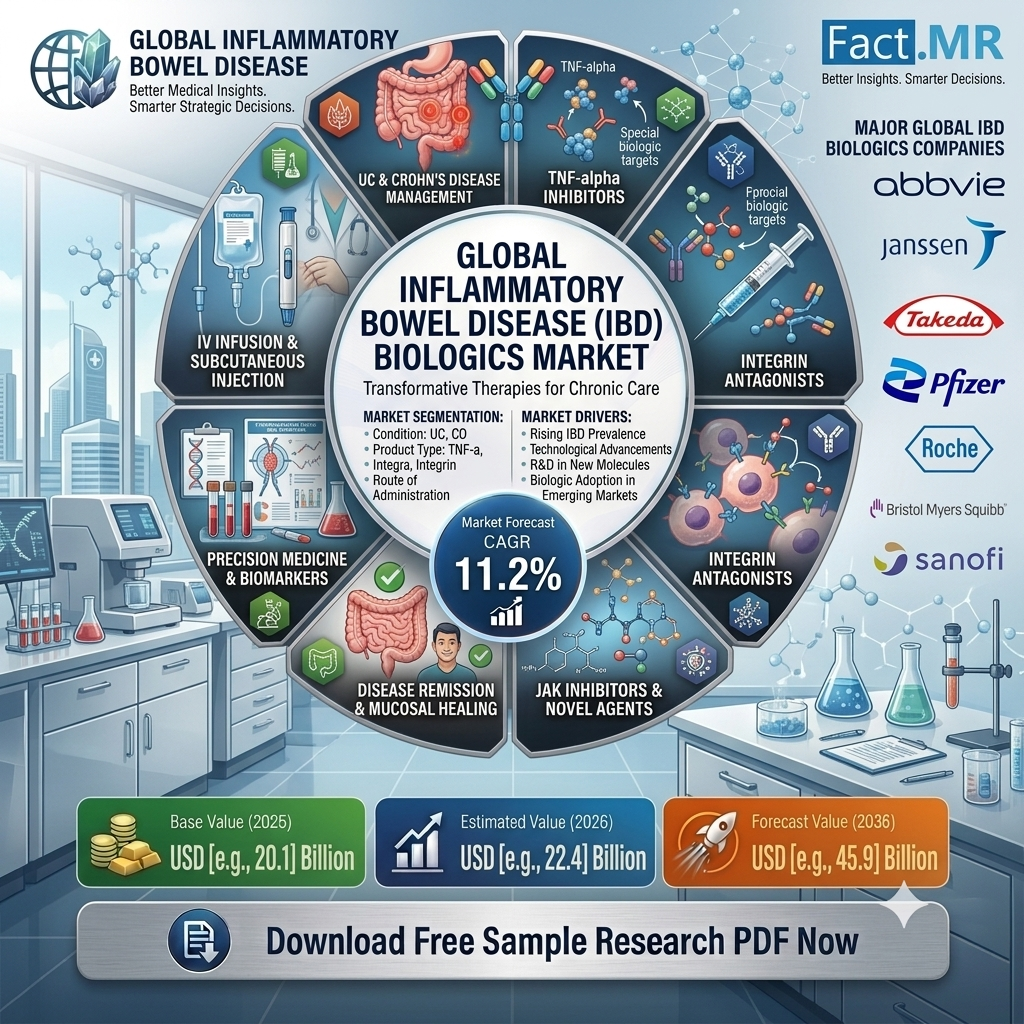
The inflammatory bowel disease biologics market is forecast to expand from USD 60.73 billion in 2026 to USD 130.81 billion by 2036, registering an 8.0% CAGR over the forecast period. Fact.MR attributes this expansion to the rising prevalence and diagnosis of inflammatory bowel disease, increasing adoption of biologics for moderate-to-severe cases, and the continued introduction of therapies with differentiated mechanisms of action.
The chronic and progressive nature of inflammatory bowel disease is creating sustained demand for treatments capable of maintaining remission and controlling disease activity over the long term. Earlier adoption of biologic therapies is also gaining importance as treatment approaches increasingly focus on preventing complications, reducing relapse, and improving long-term disease management. Advances in biologic development and biosimilars are further broadening treatment options and accessibility.
Get detailed market forecasts, competitive benchmarking, and pricing trends:
https://www.factmr.com/connectus/sample?flag=S&rep_id=13523
Anti-TNF Agents Retain Dominant Position
By product type, anti-TNF agents are expected to account for 36.1% of the inflammatory bowel disease biologics market in 2026. Their leading position is supported by more than two decades of clinical use, established safety and efficacy profiles, and increasing availability of biosimilars. Despite competition from newer therapeutic mechanisms, anti-TNF agents remain a foundational biologic option for patients with severe disease.
Crohn’s disease represents another major area of demand, accounting for 51.3% of the application segment in 2026. Its chronic and progressive nature, together with complicated manifestations such as fistulizing and structuring disease, creates significant demand for advanced biologic therapies capable of inducing and maintaining remission.
Hospital pharmacies are projected to hold 49.4% of the end-user segment in 2026. Their leading position reflects the role of hospital-based settings in administering intravenous biologics and managing complex induction regimens. These facilities also provide the infrastructure required for patient monitoring and management of potential acute reactions during treatment.
India, China, and Germany Show Strong Growth Potential
India is projected to record the fastest growth among the countries assessed, with the inflammatory bowel disease biologics market advancing at a 10.1% CAGR from 2026 to 2036. A large and increasingly diagnosed patient population is supporting market expansion. Growth is also being encouraged by the development of private specialty gastroenterology infrastructure and the gradual introduction of biosimilars, although high out-of-pocket treatment costs remain a constraint.
China follows with a projected 9.9% CAGR through 2036. Rising IBD incidence, improvements in endoscopic diagnosis, and broader inclusion of biologic medicines in the National Reimbursement Drug List are supporting market development. Domestic pharmaceutical companies are also expanding their presence through biosimilars and novel biologic therapies, increasing competition and potentially improving access.
Germany is expected to advance at a 7.9% CAGR during the same period, making it one of the stronger European markets covered in the report. The country's market is shaped by specialist treatment guidelines, clinical evidence, health technology assessments, and increasing use of biosimilars as a cost-containment strategy. These factors are supporting steady adoption while encouraging more structured sequencing of biologic therapies.
The broader market is also influenced by the USA, Brazil, and the UK. The USA is projected to grow at 9.0%, supported by high treatment rates, specialty-drug reimbursement, and adoption of newer agents. Brazil is expected to register a 9.6% CAGR, while the UK is forecast to expand at 8.0% as biologic access remains closely linked to cost-effectiveness assessments and NHS treatment pathways.
Competitive Landscape
Competition in the inflammatory bowel disease biologics market includes major pharmaceutical companies with established biologic portfolios and expanding pipelines of advanced therapies. Key companies profiled by Fact.MR include AbbVie Inc., Johnson & Johnson, Takeda Pharmaceutical Company Limited, Pfizer Inc., and Bristol-Myers Squibb Company.
Competitive positioning is influenced by clinical efficacy, safety, dosing frequency, administration convenience, and long-term treatment outcomes. Companies are also focusing on patient-support programs, lifecycle management, new formulations, and additional indications. The growing availability of anti-TNF biosimilars is adding price competition, while novel mechanisms such as IL-23 and JAK pathway targeting are creating additional areas for differentiation.
Precision Treatment and Novel Biologics Shape the Market
The market is undergoing a shift toward treat-to-target and precision medicine approaches. Biomarker monitoring and therapeutic drug monitoring are increasingly important for optimizing treatment sequences, managing immunogenicity, and supporting long-term disease control. The growing use of more convenient subcutaneous formulations and extended dosing intervals is also aimed at improving adherence and patient quality of life.
At the same time, pharmaceutical companies are continuing to develop next-generation biologics and small molecules targeting novel inflammatory pathways. These efforts are focused on improving efficacy and safety for patients who fail to respond to existing therapies. The expansion of biosimilars is also expected to influence treatment accessibility and pricing as healthcare systems seek to manage the cost of long-term biologic treatment.
As diagnosis rates increase and biologic therapies become more established in the management of moderate-to-severe inflammatory bowel disease, demand for advanced treatment options is expected to remain strong. The full Fact.MR report provides detailed forecasts, segment analysis, country-level outlooks, and competitive assessment through 2036.
Top Reports:
https://adamaamresearch.blogspot.com/2026/10/plate-and-frame-filter-press-market.html
https://zeuspage.org/blogs/68116/Plate-and-Frame-Filter-Press-Market-to-Reach-USD-2
https://kaamkaaziclub.com/read-blog/67212
https://net-pals.com/blogs/46499/Plate-and-Frame-Filter-Press-Market-to-Grow-at-5
About Fact.MR
Fact.MR is a market research and consulting company providing market intelligence, competitive analysis, and forecasting across global industries. Its research supports businesses with data-driven insights into emerging markets, technology trends, competitive dynamics, regional opportunities, and changing demand patterns.

 English
 Arabic
 French
 Spanish
 Portuguese
 Deutsch
 Turkish
 Dutch
 Russian
 Romaian
 Portuguese (Brazil)
 Greek